Monday - Friday 07:00 - 5:00

Saturday and Sunday - By Appointment

WELCOME TO

Legal Insights

self-defense law image

California Self-Defense and Use of Force

Duty to Retreat, Aggressor Rules, and Governing Legal Framework Executive Summary California does not have a stand-your-ground statute, but California appellate courts have held since 1923 that there is no duty to retreat before using force in self-defense when a person is not at fault. The rule is applied through jury instruction CALCRIM No. 3470

Read More »
Safety vs. security in contrast

Your Volunteer Safety Team and SB 1454

Practical Answers to the Questions Houses of Worship Are Actually Asking Introduction California Senate Bill 1454, effective January 1, 2024, drew a clear legal boundary between regulated security services and permissible volunteer safety activity at houses of worship. For many congregations that have operated informal safety or security teams for years, the law created immediate

Read More »
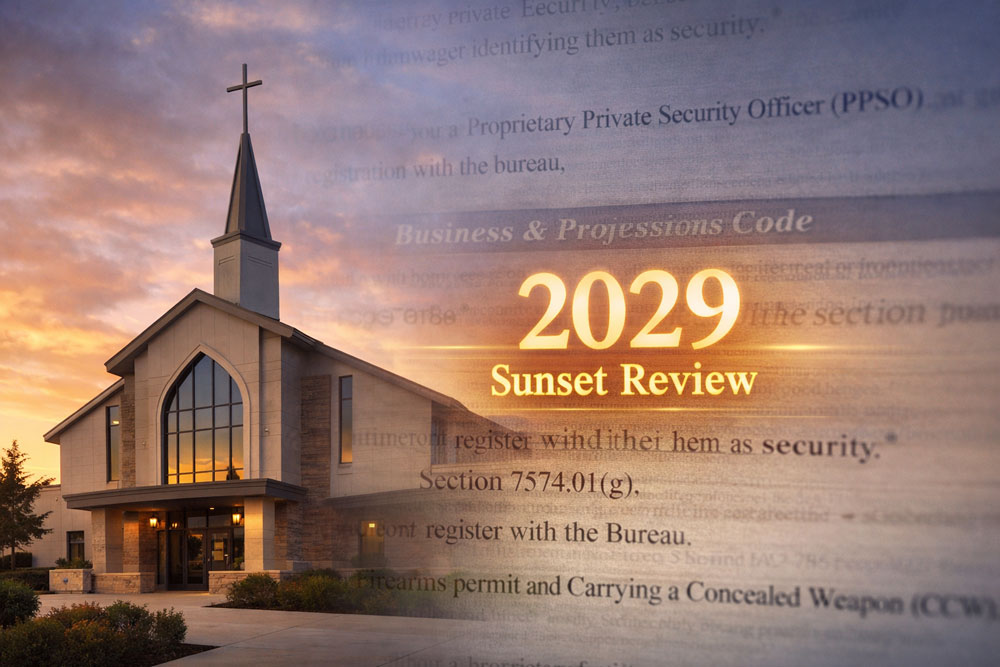
California SB 1454 Sunset Review in 2029

SB 1454 Houses of Worship Strategy Guide

California Senate Bill 1454: Impact on Houses of Worship Volunteer Security Programs A Strategic Guide to the 2029 Sunset Review Window What SB 1454 Changed for Houses of Worship On September 22, 2024, Governor Newsom signed SB 1454 into law as part of the Bureau of Security and Investigative Services (BSIS) sunset review. The bill

Read More »
A Comprehensive Analysis of Premises Liability, Negligent Security, and Wrongful Death Standards for Nonprofit Religious Institutions Under California Law

Foreseeability, Duty of Care, and Security Posture for California Houses of Worship

A Comprehensive Analysis of Premises Liability, Negligent Security, and Wrongful Death Standards for Nonprofit Religious Institutions Under California Law EXECUTIVE SUMMARY This article provides a California specific analysis of foreseeability, negligent security, and wrongful death considerations for nonprofit houses of worship. It integrates federal threat assessments from the Cybersecurity and Infrastructure Security Agency (CISA), California

Read More »
security guard entering a house of worship behind church members

Guideline for California Houses of Worship

Volunteers in Security Roles, PPO Adoption, and California Statutory Requirements 1. Purpose and Scope This guideline provides clear, actionable guidance for California houses of worship that wish to use volunteers in security-related roles or functions. It addresses the legal boundaries of volunteer involvement in security, the regulatory framework governing private security in California, and the

Read More »
sidewalk

Understanding First Amendment Rights on the Sidewalk

An Informational Essay for Houses of Worship and Nonprofit Personnel Faith-based organizations and nonprofits are increasingly encountering First Amendment auditors, provocateurs, and protestors who position themselves on public sidewalks near entrances, parking lots, or gathering areas. These individuals often film, question, or provoke staff and congregants in an attempt to elicit a reaction they can

Read More »

Responding to First Amendment Auditors at Houses of Worship 

A Practical, Legally Defensible Guide for Faith Communities Introduction Across the United States, First Amendment auditors have increasingly targeted houses of worship, synagogues, churches, mosques, gurdwaras, temples, and other faith centers by filming congregants, parking lots, and entrances. While auditors claim constitutional rights, houses of worship are private property and retain full authority to restrict

Read More »
Sumner School in Washington

When a Nonprofit Is a Tenant in a Public Building: Rights, Quiet Enjoyment, and Managing Protest Activity

Nonprofit organizations, including houses of worship, community service groups, arts organizations, and charitable programs, frequently lease space in public buildings such as schools, municipal centers, and city-owned facilities. These arrangements are lawful, common, and often mutually beneficial. Yet they can become complicated when protesters object to the nonprofit’s presence or attempt to disrupt activities. Understanding

Read More »
Scroll to Top