
Practical Answers to the Questions Houses of Worship Are Actually Asking
Introduction
California Senate Bill 1454, effective January 1, 2024, drew a clear legal boundary between regulated security services and permissible volunteer safety activity at houses of worship. For many congregations that have operated informal safety or security teams for years, the law created immediate and practical questions that are difficult to answer without legal expertise.
This article is not written for congregations starting from scratch. It is written for those that already have a thoughtfully structured volunteer safety team, one that is unarmed, trained in de-escalation and medical aid, and careful about how it presents itself to the congregation, but that still faces real uncertainty about where the compliance lines are drawn in day-to-day operations.
The questions addressed below emerged directly from conversations with house of worship safety directors navigating exactly this challenge. They are the questions that do not have obvious answers, the ones that sit at the boundary between what is clearly permitted and what may inadvertently cross into regulated territory. The analysis draws on the statutory requirements of SB 1454, the Bureau of Security and Investigative Services (BSIS) regulatory framework, California premises liability law, and published federal security guidance from the Cybersecurity and Infrastructure Security Agency (CISA).
| Disclaimer This article is for informational and educational purposes only. It does not constitute legal advice and does not create an attorney-client relationship. Houses of worship should consult qualified legal counsel before making compliance determinations specific to their organization. |
Section I: Understanding the Core Distinction: Safety vs. Security
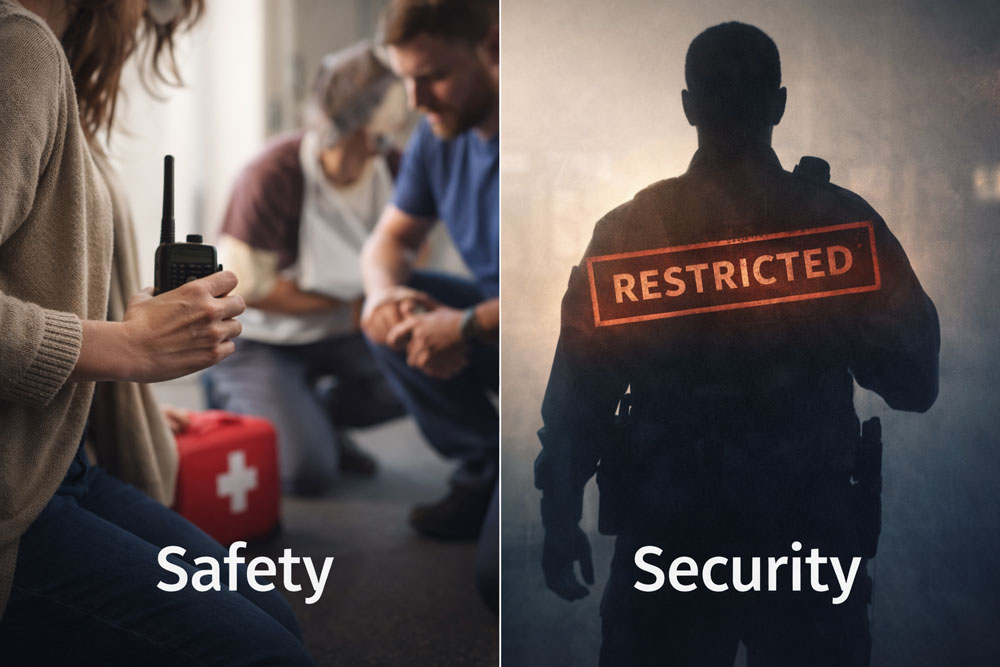
The foundation of SB 1454 compliance for volunteer teams is a single, critical distinction: the law regulates security services, not safety services. These are not the same thing, and understanding the difference determines whether your volunteers are operating lawfully.
Under California Business and Professions Code Section 7582.1, regulated security guard functions include:
- Deterring unauthorized activity through armed or authoritative presence
- Conducting security patrols of facilities or grounds
- Monitoring access points or controlling entry to premises
- Responding to security threats or disturbances with physical authority
- Exercising authority to detain or remove individuals
By contrast, BSIS regulations and the legislative history of SB 1454 make clear that the following activities are not regulated security services and may be performed by unlicensed volunteers:
- Providing medical first aid, CPR, and emergency medical response
- Assisting with emergency evacuation during fires or other emergencies
- Observing and reporting suspicious activity to staff or law enforcement
- Operating communication equipment for emergency coordination
- Monitoring weather alerts and coordinating emergency notifications
- Supporting lost child reunification protocols
- Greeting and welcoming congregants (without security authority)
- Conducting emergency drills and training exercises
The key variable in most gray-area situations is not what an activity looks like from the outside, but what authority the volunteer exercises, or appears to exercise, in performing it. A volunteer who observes and reports is functioning as a safety team member. A volunteer who confronts, controls, detains, or physically intervenes is functioning as a security officer, regardless of what their badge or written procedures say.
| The Governing Principle Observe, communicate, and support emergency responders. Do not confront, control, or physically intervene. When in doubt about whether an activity crosses into regulated territory, the answer is to call law enforcement, not to expand the volunteer’s role. |
Section II: What Constitutes Patrolling: Four Scenarios Examined
One of the most common points of uncertainty for volunteer safety teams is whether specific activities constitute regulated “security patrols.” The answer is not always obvious, because the line between observing and patrolling is defined more by purpose, authority, and conduct than by physical location. The following scenarios represent common real-world configurations.
Scenario A: The Monitoring Room
A dedicated room inside the building houses all UHF radios and a live feed monitor displaying footage from all security cameras on the premises. One Safety Team member is stationed in this room during services.
| Compliance Assessment Permitted — This is an observational and communications function, not a security patrol. BSIS regulations and the legislative record both explicitly identify “operating communication equipment for emergency coordination” and “observing and reporting suspicious activity” as non-regulated activities. A single team member monitoring cameras and coordinating radio communications is functioning as a safety communications hub, not a security officer. |
Recommended framing in your written procedures: “The communications coordinator monitors camera feeds and maintains radio contact with all Safety Team members and house of worship leadership. The coordinator does not exercise enforcement authority and responds to observed concerns by notifying appropriate personnel or calling 911.”
Scenario B: The Lobby Observer
A second Safety Team member is stationed in the lobby while ushers and greeters move congregants into the sanctuary. This member observes individuals entering the building and has the ability to lock the exterior door if suspicious activity is observed or if directed by the communications coordinator.
| Compliance Assessment Conditional — Observation at an entrance is within bounds. Greeting, watching, and reporting are all explicitly permitted. However, the door-locking function introduces a meaningful complication. The BSIS list of regulated activities includes “monitoring access points or controlling entry to premises.” Whether a volunteer locking a door constitutes regulated access control depends heavily on how and when it is done. |
The critical distinction is between discretionary judgment and protocol-driven response:
- Regulated risk: Discretionary judgment
- A volunteer decides, based on their personal assessment of an approaching person’s appearance or behavior, to lock the door — this looks like access control, which is a regulated function.
- Lower risk: Protocol-driven response
- A volunteer locks the door because a confirmed emergency has been declared and the written lockdown protocol specifies that exterior doors are secured — this is emergency response, not access control.
Recommendation: Your written procedures should remove the individual volunteer’s discretion from this decision. The trigger for locking exterior doors should be a declared lockdown initiated by house of worship leadership or law enforcement, not a volunteer’s independent assessment of a person’s threat level. Document this clearly in your emergency action plan and train your team accordingly.
Scenario C: Inter-Building Communication Relay
When suspicious individuals are observed moving between house of worship buildings on the campus, Safety Team members relay descriptions and locations to team members in adjacent buildings via radio.
| Compliance Assessment Permitted — This is straightforwardly within bounds. Sharing observed information through communication equipment for the purpose of coordinating an emergency response is explicitly recognized as a non-regulated safety function. This is precisely the kind of situational awareness activity a well-run safety team should be doing. |
Recommendation: Maintain a radio log or communications record for incidents where suspicious activity is relayed between buildings. If a situation escalates, that documentation supports your organization’s response and demonstrates the team was functioning as an observation-and-report system rather than an enforcement unit.
Scenario D: Approaching Individuals in the Parking Lot
When individuals are observed in the parking lot on a Sunday morning behaving in ways that raise concern, photographing the building, lingering without apparent purpose, or otherwise acting in a manner inconsistent with normal congregant behavior, Safety Team members approach them to make contact.
| Compliance Assessment High Risk — This activity requires careful restructuring. When a volunteer leaves a building, approaches a person on the property, and initiates contact based on a security-motivated concern about that person’s behavior, the activity begins to closely resemble “conducting a security patrol” and exercising informal authority over persons on the premises — both regulated functions under SB 1454. |
This does not mean that no one from your organization should ever engage with unusual activity in the parking lot. It means that the person doing the engaging, and the manner in which they do it, matters significantly for compliance purposes.
A recommended restructuring has two elements. First, change who makes the approach. A pastor, house of worship administrator, or designated hospitality representative, not an identified Safety Team member, should be the person who walks out to a parking lot and says, “Good morning, can I help you? Are you looking for our services today?” This is a pastoral encounter, not a security contact, and it does not implicate SB 1454 regardless of what motivated it internally.
Second, change what the Safety Team does in that situation. The Safety Team member who observed the concerning activity should document what was seen, relay it to the communications coordinator, and, if the concern is serious, call law enforcement. Their role is to maintain observation and keep leadership informed, not to be the person making contact.
| The CISA “Power of Hello” Framework The Cybersecurity and Infrastructure Security Agency recommends what it calls the “Power of Hello” approach: trained personnel who can engage unusual activity with a warm, welcoming contact rather than a confrontational one. CISA frames this as a community-relations function, not a security function. If your house of worship wants to maintain a formal capability to engage unusual parking lot activity, structuring it explicitly within a hospitality or pastoral framework — with separate documentation from your Safety Team program — provides meaningful separation from regulated security activity. |
Section III: Physical Intervention — What Safety Team Members Are and Are Not Authorized to Do
Question: If We Observe an Ongoing Fight, Can Safety Team Members Do More Than De-Escalate to Break It Up?
This question arises because the instinct to stop a physical altercation, particularly one threatening congregants, is deeply human and often well-intentioned. The legal and regulatory answer, however, is unambiguous.
SB 1454 and BSIS regulations identify “physical intervention” and “responding to security threats or disturbances” as regulated security functions. A volunteer safety team that is not licensed under BSIS is not authorized to perform these functions, regardless of the circumstances that prompt them.
Beyond the regulatory issue, there are serious independent liability concerns. A volunteer who physically intervenes in a fight can be injured. They may injure a third party, including a bystander, in ways that expose the house of worship to civil battery or negligence claims. And the intervention may escalate a manageable confrontation into a more dangerous one.
The appropriate Safety Team response to an observed fight is:
- Verbally announce, loudly and clearly, that police have been called
- Attempt verbal de-escalation if it can be done safely and without physical contact
- Create distance — move other congregants away from the altercation
- Call 911 immediately and remain on the line
- Document what was observed for your incident report
If your house of worship leadership believes that a capability to physically separate combatants is essential to your safety program, that capability requires licensed security personnel. That is precisely the kind of risk-management decision SB 1454 was designed to force.
Question: After Subduing a Threat, Are We Permitted to Detain Them Until Police Arrive?
This question involves two distinct legal frameworks that are frequently conflated, and separating them is essential to understanding the answer.
Citizen’s Arrest Under California Law
California Penal Code Section 837 recognizes the right of a private person to arrest another for a public offense, including a felony, committed in their presence. So, as a matter of California law, there is a legal basis under which a private citizen can detain someone who has committed a violent felony on the premises until law enforcement arrives. The holding itself, under those specific circumstances, is not inherently unlawful.
The More Important Question: How Did You Get There?
The legal question your house of worship needs to focus on is not whether detaining someone after subduing them is permissible. It is whether the subduing itself was permissible, and under SB 1454, it almost certainly was not if the person performing it is an unlicensed volunteer.
Physically overpowering or restraining a threatening individual is a use-of-force security function. It is among the most clearly regulated activities under SB 1454. A Safety Team member who physically subdues a person, even a genuinely dangerous one, has performed a regulated security function without a license, regardless of the outcome or the righteousness of the motivation.
The consequences of that unlicensed action include personal criminal exposure for the volunteer, potential void of your house of worship’s insurance coverage for the incident, and civil liability for the house of worship arising from the unlicensed security activity itself.
| The Practical Answer If someone enters your property and begins threatening people — with or without a weapon — your Safety Team’s role is to execute your emergency action plan: initiate lockdown, evacuate or shelter congregants in place, call 911, keep people away from the threat, and provide real-time information to arriving law enforcement. Armed confrontation, physical takedowns, and active restraint are outside the scope of a compliant, unlicensed volunteer team. If your congregation’s risk profile makes a physical intervention capability feel essential, that is the clearest possible argument for contracting a licensed armed officer for service coverage. |
Section IV: Badges, Uniforms, and How Your Team Presents Itself
Question: Our Safety Team Members Wear a Badge That Says Only “SRT.” Is That Permitted?
The short answer is yes, with an important qualification.
Nothing in SB 1454 or BSIS regulations prohibits a volunteer safety team member from wearing identification. A badge that says “SRT”, with no language suggesting security authority, enforcement status, or law enforcement affiliation, does not on its face constitute regulated security activity.
The relevant guidance from SB 1454 compliance analysis focuses on avoiding language that implies authority over persons. Badges or identification that use the words “Security,” “Guard,” “Officer,” “Patrol,” or similar terms suggest a regulated function and should be avoided.
However, and this qualification matters, the badge is not what determines compliance. Conduct determines compliance. A volunteer wearing an “SRT” badge who walks up to someone in the parking lot and tells them they need to leave, or who physically prevents someone from entering a building, or who restrains someone after a confrontation, has performed regulated security functions regardless of what their badge says. The badge is a data point that courts and regulators might consider, but it is not a shield against liability if the conduct crosses the line.
| Recommended Practice Keep the “SRT” badge. Make sure the badge does not include language implying security authority. More importantly, ensure that your written procedures, your training protocols, and your team’s day-to-day conduct all consistently match the non-security framing your badge communicates. Presentation and conduct must be aligned. |
On Uniforms Generally
The absence of uniforms is a meaningful compliance indicator, and it is worth acknowledging that this is a well-considered choice. Uniformed personnel exercising authority functions are more easily characterized as regulated security guards. A team that wears civilian clothing and carries only modest identification is signaling, in a legally relevant way, that it is not functioning as a security force.
This does not mean uniforms are prohibited. It means that any team presenting itself in a manner that closely resembles a traditional security force should be especially attentive to the conduct side of the compliance equation. The more your team looks like security, the more scrutiny its activities will receive.
Section V: Compliance At a Glance
The following table summarizes the compliance status of the specific activities discussed in this article and provides recommended practice guidance for each.
| Activity | SB 1454 Status | Recommended Practice |
| Camera monitoring room | ✓ Permitted | Frame as communications/coordination function; restrict to observation and radio relay only |
| Lobby observation post | ⚠ Conditional | Permitted if observational; door-locking must be protocol-driven, not discretionary judgment about individuals |
| Inter-building radio relay | ✓ Permitted | Explicitly permitted; maintain logs of communications for incident documentation |
| Approaching parking lot visitors | ✗ Caution | Reframe as pastoral hospitality; staff or clergy should approach, not SRT; call law enforcement for genuine threats |
| Physical fight intervention | ✗ Not Permitted | Verbal de-escalation only; call 911; focus on evacuating bystanders, not stopping altercation |
| Detaining a threat after subduing | ✗ Avoid | Citizen’s arrest exists in CA law but the subduing itself is a regulated function; defer to law enforcement |
| ERT badge (no security language) | ✓ Permitted | Acceptable; avoid words like Security, Guard, or Officer; conduct must match the non-security framing |
Section VI: The Written Procedures — Your Most Important Compliance Document
Throughout this analysis, repeated reference has been made to your written procedures. This is not incidental. The written procedures for your volunteer safety team are the single most important compliance document your organization can maintain, for several reasons.
First, it defines the program’s legal character. A written procedure that explicitly states that the team does not provide security services, does not exercise enforcement authority, does not detain individuals, and does not perform armed patrols establishes the legal framework within which your team operates. If a compliance question ever arises — with a regulator, an insurer, or in litigation — that document is the first thing examined.
Second, it guides training and conduct. Volunteers who have signed and internalized clear written procedures are less likely to improvise in ways that cross the compliance line. The written procedures document is only as valuable as the training and acknowledgment process that accompanies it.
Third, it protects individual volunteers. A volunteer who acts within the scope of a clearly documented, SB 1454-compliant written procedures document is in a fundamentally different legal position than one operating without clear written authorization and limitations.
What Your Written Procedures Should Explicitly Include
- A clear statement of the team’s mission: emergency preparedness, medical response, emergency evacuation, and communications coordination
- An explicit statement that the team does not provide security services as defined under California Business and Professions Code Section 7582.1
- Specific prohibitions: armed patrol, physical intervention, detention of individuals, representing team members as security personnel
- A description of permitted activities aligned with the BSIS-recognized list of non-regulated safety functions
- A clear chain of command and escalation protocol specifying when and how law enforcement is contacted
- A signed acknowledgment page for every team member
Section VII: Insurance and Documentation
SB 1454 compliance is not only a regulatory matter; it may also affect the placement or renewal of your house of worship’s insurance coverage. Most major carriers offering house-of-worship liability policies have updated their underwriting guidelines in response to the legislation.
Carriers may exclude future coverage for unlicensed personnel performing regulated security functions. If a Safety Team member physically intervenes in a fight, attempts to detain a threatening individual, or performs armed patrol without a BSIS license, and an injury results, your insurer may deny the claim on the grounds that the individual’s activity is specifically excluded under your policy terms.
Carriers view properly structured safety ministries favorably. A well-documented, SB 1454-compliant volunteer safety program, with a clear written procedure, training records, incident logs, and a track record of calling law enforcement rather than self-help enforcement, is the kind of program that supports favorable underwriting and coverage continuity.
Recommended documentation practices:
- Maintain complete training records for every Safety Team member, including dates, topics covered, and attendance
- Keep signed written procedures and acknowledgments on file
- Document all incidents using a standardized incident report form
- Maintain records of law enforcement coordination, including any building assessments, plan reviews, or patrol requests
- Conduct an annual policy review with your insurance agent, specifically disclosing your safety program and confirming coverage status
Section VIII: When a Volunteer Safety Team Is Not Enough
This article focuses on how to structure a compliant volunteer safety team. But an honest treatment of the subject requires acknowledging when that structure is insufficient.
The analysis of California premises liability law is clear on one point: the reasonableness of a house of worship’s security measures depends on the foreseeability and severity of risk at that specific location. CISA has documented a real and potentially growing trend of targeted violence against houses of worship. Federal guidance now puts house of worship leadership on notice that this risk exists and that a documented, multi-layered response is expected.
For most congregations, particularly smaller ones in lower-risk environments with no history of threats or incidents, a well-structured, SB 1454-compliant volunteer safety team satisfies the reasonable care standard under California law. The liability framework does not demand armed security absent specific, heightened threat indicators.
However, certain circumstances change that calculus:
- Your congregation has received specific, credible threats
- Your facility has experienced prior incidents of violence or threatening behavior
- Your location or congregation profile places you in a higher-risk category identified by federal threat assessments
- Your attendance and facility size are such that a volunteer team cannot realistically provide adequate situational coverage
In any of these circumstances, the preferred solution identified by SB 1454 compliance analysis is contracting with either a licensed private security firm or a law enforcement agency for off-duty officer coverage during service times. This approach transfers liability to the contracting entity, ensures proper licensing and training, and provides capabilities a volunteer team cannot lawfully exercise.
The question to put to your leadership is not whether you can afford professional security coverage. It is whether the consequences of an incident in the absence of that coverage, for your congregation, your legal exposure, and your insurance position, exceed the cost of providing it.
Section IX: California Self-Defense Doctrine — Defense of Self or Others
Nothing in SB 1454, BSIS regulations, or the discussion of compliant volunteer team design eliminates a fundamental legal right: any person in California, volunteer, staff member, congregant, or bystander may defend themselves or others from imminent harm. This right exists independently of licensing requirements and independently of any role a person holds within a house of worship safety program.
This section does not describe the function of the Safety Response Team. It describes a legal doctrine that applies to every individual present on your premises. Understanding it and training your team to understand it are important components of a complete safety program.
A. The Legal Foundation
California Penal Code Sections 197 and 198, together with California Civil Jury Instructions (CALCRIM) 505 and 3470, establish the framework for lawful self-defense and defense of others in California. The doctrine is grounded in a simple but carefully bounded principle: a person may use force to protect themselves or another person from imminent harm, provided the force is reasonable and proportionate to the threat.
Critically, this is a personal right, not an organizational function. A Safety Team member who physically intervenes to stop an active attack on a congregant is not exercising an SB 1454-regulated security function in that moment; they are exercising the same legal right that any bystander on the street would possess. SB 1454 regulates organized, programmatic security services. It does not and cannot strip any individual of the right to defend their life or the lives of others in a moment of genuine crisis.
| The Critical Distinction SB 1454 governs what your Safety Team does as an organized program. California’s self-defense law governs what any individual may do when faced with an imminent threat to life. These are separate legal frameworks operating in separate contexts. Your written procedures should address both clearly and independently. |
B. The Four Prongs of Lawful Self-Defense in California
For any use of force to be legally justified as self-defense or defense of others under California law, all four of the following elements must be present. These are not optional considerations; they are the prongs courts and juries apply when evaluating whether the use of force was lawful. Each is discussed below.
Prong 1: Reasonable Belief of Imminent Danger
The person using force must have reasonably believed that they or another person was in imminent danger of being killed, seriously injured, or unlawfully touched. Both elements of this prong matter:
- Objective standard: Reasonable belief
The belief must be one that a reasonable person in the same situation would have held. A purely subjective fear, “I was scared,” is not sufficient if a reasonable person would not have perceived an imminent threat under the same circumstances.
- Temporal standard: Imminent danger
The threat must be immediate and present, not anticipated, speculative, or based on past events. A threat that may materialize in the future does not justify the use of force now. The danger must be happening or about to happen.
Prong 2: Necessity — No Reasonable Alternative
The person must have reasonably believed that using force was necessary to prevent the danger. This prong incorporates a proportionality of response analysis: if the threatened harm could reasonably have been avoided through a lesser response, such as retreating, creating distance, calling for help, the use of force may not satisfy the necessity requirement.
California does not impose a strict duty to retreat before using force in self-defense. However, whether retreat or de-escalation was available and reasonable is a factor courts consider in evaluating whether force was truly necessary.
Prong 3: Proportionate and Not Excessive Force
The amount of force used must not exceed what was reasonably necessary to defend against the threat. This is the proportionality prong, and it is one of the most commonly litigated elements in self-defense cases.
The doctrine distinguishes between two levels of force:
- Non-deadly force (ordinary force) may be used to defend against a threat of bodily harm that is not life-threatening or capable of causing great bodily injury.
- Deadly force — force likely to cause death or great bodily injury — is only justified when the person reasonably believed they or another faced imminent death or great bodily injury.
The practical implication: a response that significantly exceeds the threat — using deadly force against a non-lethal threat, or continuing force after the threat has ended — is not protected by the self-defense doctrine and may constitute criminal assault, battery, or homicide.
Prong 4: The Defender Did Not Act as the Initial Aggressor
A person who provokes a confrontation or is the initial aggressor in a fight cannot claim self-defense without first withdrawing from the confrontation and communicating that withdrawal clearly. This prong is particularly important for volunteer safety teams to understand, because it means that any approach, challenge, or physical contact that initiates or escalates a confrontation — even one motivated by a genuine safety concern — can undermine a subsequent self-defense claim if force is later used.
This is one of the strongest arguments for the posture described throughout this article: observe, communicate, create distance, and call law enforcement. A Safety Team member who approaches a suspicious individual in the parking lot, makes physical contact, or issues commands they have no legal authority to give may inadvertently become the legal aggressor in any confrontation that follows, eliminating the self-defense protection they might otherwise have had.
C. Defense of Others — Applying the Same Standard
California law recognizes the right to use force to defend a third party on the same terms as self-defense. Under CALCRIM 3470, a person may use force to defend another if they reasonably believed the other person was in imminent danger of harm, and that using force was necessary to prevent that harm, and the force used was not more than necessary.
For Safety Team members and house of worship staff, this means the doctrine extends to the protection of congregants, children, and any other person on the premises. If a member of your team witnesses an active attack on another person and intervenes with force, their legal justification is evaluated under the same four prongs described above, applied from the perspective of what they reasonably perceived and what was proportionate to the threat they observed.
| A Practical Note on Articulation If a use of force occurs — by a staff member, volunteer, or Safety Team member — the ability to clearly articulate the specific facts that supported the belief of imminent danger is critical. Vague statements such as “I felt threatened” or “they seemed dangerous” carry little legal weight. Specific, factual descriptions — “the individual produced a knife and moved toward the congregant” or “the person announced they had a firearm and intended to use it” — are the kind of articulation that supports a lawful self-defense claim. Train your team to document not just what happened, but why they reasonably believed the threat was imminent and what specific facts they observed. |
D. CCW Holders on House of Worship Premises
Some Houses of Worship have staff members or congregants who hold California Concealed Carry Weapon (CCW) licenses. The self-defense doctrine applies to licensed CCW carriers in the same way it applies to anyone else; the use of a firearm in self-defense or defense of others must satisfy all four prongs described above.
For Houses of Worship that permit CCW carry on premises, the written procedures should specifically address the role, if any, of known CCW holders within the safety program. The relevant considerations include:
- A CCW license authorizes concealed carry; it does not authorize the holder to perform security functions, patrol, or exercise authority over other persons on the property. CCW holders are private citizens, not security personnel, for purposes of SB 1454.
- If a CCW holder uses force in defense of self or others, they are subject to the same legal standard as any other private citizen; the lawfulness of the use of force is evaluated under the four-prong self-defense doctrine, not by reference to their license.
- The decision to draw and use a firearm in a crowded sanctuary environment carries significant additional considerations beyond the self-defense doctrine itself, including risk of harm to bystanders, the response of arriving law enforcement who will see an armed individual, and the factual complexity of rapidly evolving situations.
- Houses of Worship should consult legal counsel before establishing any formal or informal role for CCW holders within their safety program. Permitting or encouraging CCW holders to act as de facto armed security, even informally, creates SB 1454 compliance risk.
E. What to Include in Your Written Procedures
Your written procedures should address the self-defense doctrine in a way that is accurate, clear, and honest, neither overstating the right to intervene nor leaving team members without guidance when facing a genuine life-safety emergency. The following elements are recommended:
- A clear statement that Safety Team members are not authorized to perform security functions, physical intervention, or use of force as part of their organizational role.
- A clear statement that nothing in the written procedures eliminates any individual’s personal legal right to defend themselves or others from imminent harm under California law.
- A description of the four prongs of lawful self-defense, so team members understand the standard they will be held to if force is ever used.
- An explicit articulation requirement: in any incident involving use of force, the team member must be able to document the specific observable facts that supported their reasonable belief of imminent danger.
- A protocol for post-incident documentation and immediate notification of law enforcement and house of worship leadership.
- Language advising team members to consult personal legal counsel regarding their individual rights and responsibilities, particularly if they are licensed CCW carriers.
| Important Limitation Including self-defense doctrine in your written procedures is not a substitute for legal advice. The application of this doctrine to specific facts is highly context-dependent. Staff and volunteers should understand the framework described here as background knowledge — not as authorization to use force, and not as a guarantee of legal protection in any particular situation. Any use of force, however well-intentioned, should be treated as a serious legal event requiring immediate law enforcement contact and legal consultation. |
Conclusion
Houses of worship that have thoughtfully structured their volunteer safety programs are in a stronger compliance position than they may realize. A team that is unarmed, trained in de-escalation and medical response, clearly structured as a safety ministry rather than a security force, and disciplined about calling law enforcement rather than self-help enforcement has already addressed the core requirements of SB 1454.
The questions that create uncertainty, about monitoring rooms and lobby observers, about parking lot engagement and physical intervention, about badges and detentions, are answerable. They require not a complete restructuring of your program but a careful look at specific activities, a tightening of written procedures, and a consistent alignment between what your written procedures say and what your team actually does.
The central discipline that SB 1454 demands of volunteer safety teams can be stated simply: observe, communicate, and support emergency responders. When a situation exceeds that role, the answer is to call 911 and execute your emergency action plan — not to expand what your volunteers are authorized to do.
That discipline, consistently applied, is both legally compliant and genuinely protective of your congregation.