
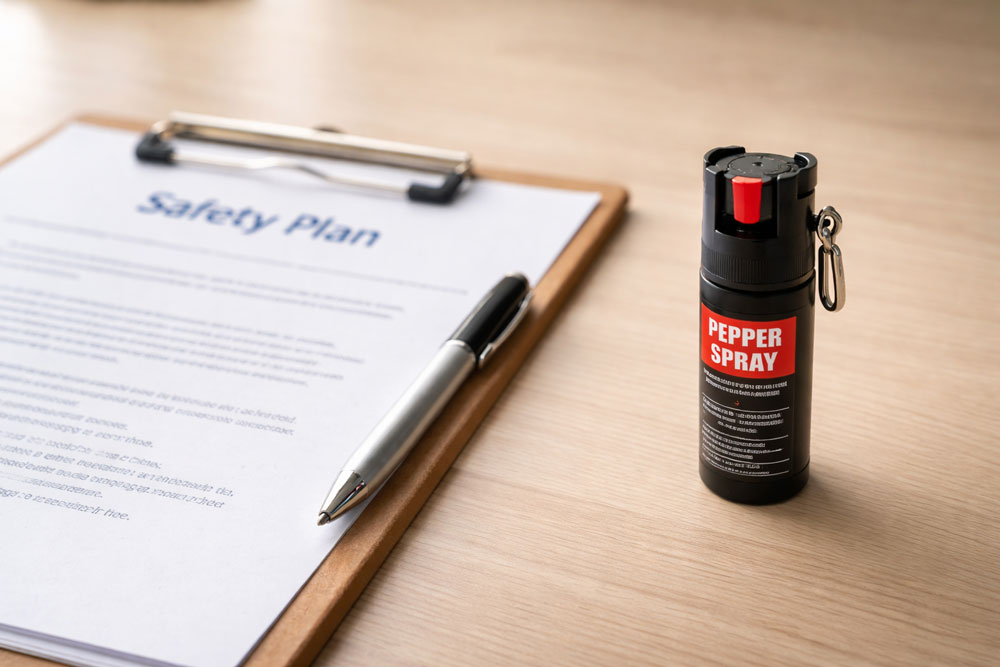
Pepper Spray, Byrna Launchers, Bear Spray, and What California Law Actually Permits
A recurring question from California houses of worship: “Our volunteers do not hold CCW permits or BSIS licenses, and we are not in a position to stand up a Private Patrol Operator structure. Can they at least carry pepper spray, a Byrna, or bear spray as a last line of defense?”
The answer is more nuanced than most internet forums, product retailers, and even some church-security vendors suggest. California regulates less-lethal tools through overlapping bodies of law — and for bear spray, federal pesticide law adds a second enforcement regime on top of state law. The correct answer depends on which tool, who is carrying it, and in what role. Getting any of these wrong can expose a volunteer to criminal charges, expose the congregation to licensing violations under SB 1454, and void insurance coverage after an incident.
This article sets out the framework in plain language, explains what each common less-lethal tool actually is under California law, and gives practical guidance that keeps your people and your ministry on the right side of the line.
| BOTTOM LINE UP FRONT Aerosol pepper spray (under 2.5 oz, properly labeled) is legal for a qualifying adult to carry for personal self-defense. Byrna or PepperBall launchers with OC/pepper projectiles are prohibited for any person who is not a qualifying BSIS licensee. Byrna with kinetic-only rounds is legal to possess as a civilian, but should not be issued as an assigned security tool to a volunteer. Bear spray is not a lawful California civilian self-defense product against people. Standard bear spray canisters exceed the statutory 2.5-ounce ceiling and carrying one for human self-defense is prosecutable under both California Penal Code § 22810 and the federal Insecticide, Fungicide, and Rodenticide Act (FIFRA). SB 1454 (effective January 1, 2025) does not add new weapon-specific rules, but it fundamentally changes how a “volunteer” is classified the moment that person takes on a recognizable security role. |
Part 1: The Bodies of Law That Regulate Less-Lethal Tools
Before looking at any specific device, it helps to understand the statutory frameworks that regulate less-lethal tools in California. Most confusion in this area comes from people applying the wrong framework to the wrong device — and for one product, bear spray, a federal framework applies on top of state law.
1. Penal Code § 22810 et seq. — Tear Gas and Tear Gas Weapons
California Penal Code § 22810 allows any qualifying adult to purchase, possess, or use tear gas or a tear gas weapon solely for self-defense.
California courts have interpreted “tear gas” broadly. It includes OC (oleoresin capsicum, the active ingredient in pepper spray and in bear spray), PAVA, CS, CN, CR, bromoacetone, xylyl bromide, and Mace. (See People v. Autterson (1968) 261 Cal.App.2d 627.) That means both pepper spray and bear spray are legally tear gas weapons in California — not just aerosol CS gas.
The key restriction is § 22810(e)(1), which prohibits any tear gas weapon that expels a projectile, or that expels the chemical by any method other than an aerosol spray, or that contains more than 2.5 ounces net weight of aerosol spray. This is the statutory source of both the familiar 2.5-oz size cap on pepper spray, the outright civilian ban on pepper-projectile launchers, and the regulatory collision that makes bear spray unlawful as a human-self-defense tool in California.
2. The Federal Insecticide, Fungicide, and Rodenticide Act (FIFRA) — 7 U.S.C. § 136 et seq.
This is the body of law most church-security guidance misses entirely. Bear spray is classified as a pesticide and regulated by the U.S. Environmental Protection Agency (EPA) under FIFRA. Every bear spray product lawfully sold in the United States must be registered with EPA and must bear an EPA Registration Number on the label.
FIFRA makes it unlawful, at 7 U.S.C. § 136j(a)(2)(G), to “use any registered pesticide in a manner inconsistent with its labeling.” Because every EPA-registered bear spray label limits authorized use to deterring attacking or imminently attacking wildlife, the intentional use of bear spray against a human being is an off-label use and is unlawful under federal pesticide law independent of any state criminal liability. This is a separate enforcement exposure that does not go away when a state self-defense defense succeeds.
3. Business & Professions Code Chapter 11.4 — The Proprietary Security Services Act
This is the SB 1454 landscape. A Proprietary Private Security Officer (PSO) is an unarmed employee who wears a uniform and interacts with the public. Under B&P Code § 7574.39(b), a registered PSO cannot carry a firearm, baton, stun gun, electronic control device, or any chemical agent — including pepper spray. The employer-side parallel is § 7574.38(d), which makes it unlawful for the employer to permit such carry. Violations carry fines: $1,000 per violation against the officer under § 7574.40(f); $2,500 per violation against the employer.
SB 1454, signed September 22, 2024 and effective January 1, 2025, removed the long-standing charitable/faith-based exemption from this regulatory scheme. That is the single most important change for California houses of worship in a generation, and it is the reason this guidance cannot be a copy-and-paste of what was true in 2022.
4. Business & Professions Code Chapter 11.5 — The Private Security Services Act
This is the Private Patrol Operator (PPO) and BSIS-licensed security guard framework. Guards licensed under this chapter can, with appropriate permits and training: carry a firearm (BSIS firearms permit), carry a baton (baton permit), and carry tear gas weapons under Penal Code § 22835 after the required chemical-agent training.
This is the only pathway under California law by which a non-peace-officer can lawfully carry a tear-gas projectile device, and it is not available to a person who is simply a congregational volunteer. It requires being a licensed employee working under a PPO.
Part 2: Tool-by-Tool Analysis
Aerosol Pepper Spray (OC)
Status: Legal for qualifying adults, with important conditions
This is the one category where a non-licensed volunteer has a clear lawful pathway. Aerosol OC pepper spray is permitted under Penal Code § 22810 for personal self-defense, subject to the following requirements:
- Size: The canister must contain no more than 2.5 ounces net weight of aerosol spray. Larger canisters fall outside the statutory exception and can be charged as unlawful tear gas weapons.
- Delivery: Must be aerosol only. Anything that expels a projectile is outside the exception.
- Age: The carrier must be 18 or older, except that minors 16 or older may possess with a parent or guardian present or with written parental consent under Penal Code § 22815.
- Eligibility: The carrier must not be a convicted felon, must not have a conviction for an assault offense or for misuse of tear gas, and must not be addicted to a narcotic drug.
- Labeling: The canister must carry the statutorily required warning label under § 22810(e)(2), the useful-life expiration date disclosure under § 22810(e)(3), and must be accompanied at purchase by printed instructions for use. Canisters sold after March 1, 1994 must also include an insert with directions for use, first-aid information, safety and storage information, and an explanation of the legal consequences of improper use (§ 22810(e)(4), (f)).
- Purpose: Possession and use are restricted to self-defense. Any use other than self-defense is a wobbler under § 22810(g)(1), punishable by up to one year in county jail and a fine not to exceed $1,000, or by imprisonment for 16 months, two, or three years. Use against a peace officer engaged in official duties carries an enhanced minimum sentence under § 22810(g)(2). Pulling the canister as a threat in any context other than responding to an immediate threat is itself a violation of § 22810 — even if the spray is never discharged.
Compliant commercial products include civilian-size canisters from Sabre, Mace Brand, and Fox Labs packaged at 0.5, 1.5, or 2.0 ounces. These are the lawful California self-defense chemical products.
Note a critical nuance: an individual volunteer may lawfully carry a compliant pepper spray canister in his or her personal capacity for self-defense. That is very different from the house of worship issuing pepper spray to a uniformed or publicly designated safety team member as part of an assigned security role. The first is a matter of personal self-defense law; the second triggers SB 1454 analysis and, under § 7574.39(b), would cross a bright statutory line.
Byrna and PepperBall Launchers — With OC/Pepper Projectiles
Status: Prohibited for non-licensed civilians
This is the category most likely to cause serious legal trouble, because the retail marketing often suggests these devices are “legal in all 50 states.” Byrna’s own website is honest about the California exception: the company does not ship pepper projectiles to California.
Under Penal Code § 17250, a “tear gas weapon” includes any cartridge capable of being discharged that releases tear gas, and any device intended for the projection or release of tear gas. A Byrna or PepperBall round containing OC is, by both function and statute, a tear gas cartridge fired from a tear gas weapon. Penal Code § 22810(e)(1) then prohibits civilians from possessing any tear gas weapon that expels a projectile.
The only carve-out is Penal Code § 22835, which permits BSIS-licensed private investigators, Private Patrol Operators, and BSIS-registered security guards employed by a PPO to carry tear gas weapons in the course of licensed activity, after completing required chemical-agent training. The Bureau of Security and Investigative Services has confirmed this reading in its official guidance document Clarification Regarding Tear Gas and Other Deadly Weapons, which states that individuals who do not hold a license and are not employed pursuant to § 22835 may not purchase, possess, or use any projectile tear gas weapon.
| WARNING A non-licensed volunteer who carries a Byrna loaded with OC rounds at a California house of worship is committing a crime under Penal Code § 22810, regardless of the volunteer’s good intentions, regardless of whether the facility is posted under § 26230(a)(22), and regardless of what the retailer told the purchaser. This is a wobbler offense punishable by up to three years in state prison. |
Worth monitoring: Byrna Technologies and an individual plaintiff filed Schiller v. Bonta in the Southern District of California in December 2025, challenging the pepper-projectile ban on Second Amendment grounds. Until that case resolves in plaintiffs’ favor — which is not certain and not soon — the statute controls.
Byrna and Similar Launchers — With Kinetic-Only Rounds
Status: Legal to possess as a civilian, but not advisable as an assigned security tool
A CO2-powered launcher firing only kinetic projectiles (hard polymer, rubber, “eco-kinetic”, or similar inert rounds with no chemical payload) does not contain or release tear gas. It falls outside § 17250’s tear gas weapon definition and outside the § 22810(e)(1) projectile prohibition.
Instead, it falls within the definition of a “BB device” at Penal Code § 16250(a): any instrument that expels a projectile through air, gas, or spring pressure. A civilian may own and possess a BB device without a license. However, several constraints apply:
- Imitation firearm rules: Under Penal Code § 16700, a device that looks substantially like a firearm is an “imitation firearm.” California imposes fluorescent-marking and blaze-orange requirements on such devices, and § 20170 restricts public display.
- Brandishing: Penal Code § 417.4 makes it a misdemeanor to draw or exhibit a BB device in a threatening manner.
- Local ordinances: Many California cities — including Los Angeles, San Francisco, and San Diego — prohibit discharging BB devices within city limits. These ordinances are not preempted by state law.
So: a kinetic-only Byrna is legal to own. But it should not be issued to a volunteer as part of an assigned security role. The moment a kinetic launcher is part of a designated security posture, the volunteer’s role almost certainly falls within the PSO or security-guard definitions, and the analysis in Part 3 of this article kicks in.
Bear Spray — A Dual Federal and State Regulatory Problem
Status: Not a lawful California civilian self-defense product against people. Use on a human violates both California and federal law.
Bear spray is the most commonly misunderstood less-lethal product in California. Two distinct regulatory regimes apply to it simultaneously, and a product that is lawful under federal pesticide law may nevertheless be unlawful to carry or use for self-defense under California law. Church security coordinators, insurers, and volunteers routinely get this wrong. This section walks through both regimes in detail.
The Federal Regime: EPA Registration Under FIFRA
Bear deterrent spray is classified as a pesticide and regulated by the United States Environmental Protection Agency under the Federal Insecticide, Fungicide, and Rodenticide Act, 7 U.S.C. § 136 et seq. Every bear spray product lawfully sold in the United States must be registered with EPA and must bear an EPA Registration Number (EPA Reg. No.) on the label. There is no single EPA number for “bear spray” as a product category; registration is issued per product and per manufacturer.
The four principal EPA-registered bear deterrent products currently on the U.S. market are:
- UDAP Pepper Power Bear Deterrent — EPA Reg. No. 72007-1
- Counter Assault Bear Deterrent — EPA Reg. No. 55541-2
- Frontiersman Bear Attack Deterrent — EPA Reg. No. 72265-1
- Guard Alaska Bear Spray — EPA Reg. No. 61311-5
All four use Capsaicin and Related Capsaicinoids (CRC) as the active ingredient, at concentrations of approximately 1.0–2.0% as established by EPA. EPA-stamped product labels are archived in the EPA Pesticide Product Label System (PPLS) and confirm that the registered use is to deter bears and, on some labels, other large predators — mountain lions, cougars, lynxes, other large cats, dogs, and moose — that are attacking or appear likely to attack humans.
FIFRA’s core prohibition at 7 U.S.C. § 136j(a)(2)(G) makes it unlawful “to use any registered pesticide in a manner inconsistent with its labeling.” Because every EPA-registered bear spray label limits authorized use to attacking or imminently attacking wildlife, the intentional use of bear spray against a human being is an off-label use and is unlawful under federal pesticide law, independent of any state criminal liability.
The California Regime: Tear Gas Weapon Classification
California regulates all oleoresin capsicum and related aerosol chemical defense products — including standard pepper spray and bear spray — as “tear gas weapons.” The governing statutes are Penal Code § 17240 (defining “tear gas weapon”), Penal Code § 22810 (civilian purchase, possession, and use), and Penal Code § 22815 (minors).
Penal Code § 22810 permits adults to purchase, possess, and use tear gas weapons “solely for self-defense purposes,” but the statute imposes requirements that bear spray cannot satisfy:
- 2.5-ounce aerosol ceiling. § 22810(e)(1) prohibits purchase, possession, or use of any tear gas weapon that contains more than 2.5 ounces net weight of aerosol spray, that expels the agent by any method other than an aerosol spray, or that expels a projectile.
- Prohibited possessors. Felons, persons convicted of any assault offense, persons convicted of misuse of tear gas under § 22810(g), and persons addicted to any narcotic drug are barred from purchase, possession, or use (§ 22810(a)–(b)).
- Minors. Minors under 16 are barred; minors 16–17 require a parent or guardian’s presence at purchase, or written parental consent (§ 22815).
- Mandatory labeling and inserts. Every lawfully sold tear gas weapon must bear the statutory warning label, a useful-life expiration disclosure, printed instructions for use, and (after March 1, 1994) an insert including directions for use, first-aid information, safety and storage information, and the legal consequences of improper use (§ 22810(e)(2)–(4), (f)). Bear spray labels are designed for FIFRA wildlife-deterrent compliance, not for § 22810 human-self-defense compliance.
- Penalties for misuse. Any use of tear gas or a tear gas weapon other than in self-defense is a wobbler under § 22810(g)(1), punishable by up to one year in county jail and a fine not to exceed $1,000, or by imprisonment under Penal Code § 1170(h) for 16 months, or two or three years, or by both. Use against a peace officer engaged in official duties carries an enhanced minimum of 16 months to three years under § 22810(g)(2).
The Regulatory Collision: Why Bear Spray Is Problematic in California
Every EPA-registered bear spray product on the U.S. market is sold in canister sizes substantially larger than the 2.5-ounce ceiling imposed by § 22810(e)(1). Common commercial bear spray canisters range from 7.9 ounces (225 g) to 13.4 ounces (380 g). The practical consequences flow directly from this size mismatch.
- Bear spray is not a lawful California civilian self-defense product. A standard bear spray canister carried on the person or in a vehicle for the purpose of defense against humans falls within the “tear gas weapon” definition and exceeds the 2.5-ounce statutory ceiling, exposing the carrier to prosecution under § 22810.
- Using bear spray against a person violates both regimes. An intentional deployment of bear spray against a human being is (a) off-label use unlawful under FIFRA, 7 U.S.C. § 136j(a)(2)(G), and (b) use of a tear gas weapon independently punishable under Penal Code § 22810(g) unless objectively justified as self-defense. A state self-defense justification, if available, is a defense to the California charge but does not cure the federal FIFRA violation.
- Bear spray in genuine wildlife contexts. California contains no statutory safe harbor exempting bear deterrent use from the § 22810 framework. However, possession and use of an EPA-registered bear spray in bear country, consistent with the product label, for its labeled wildlife-deterrent purpose, is not the type of conduct § 22810 was designed to reach, and enforcement in that posture is uncommon. The statutory text contains no wildlife exception; prosecutorial discretion is the only practical shield.
| WARNING A California nonprofit that stocks, stores, distributes, or trains volunteers with bear spray as a defensive tool against people is creating exposure under two separate enforcement regimes — state and federal. A volunteer who deploys bear spray on a human aggressor faces prosecution under California Penal Code § 22810(g), potential additional charges under Penal Code § 244 (assault with caustic chemicals, a felony), and an independent federal enforcement exposure under FIFRA that no state self-defense defense can reach. Do not use bear spray as a human-defense tool. |
The California-Legal Alternative
For civilian, security, and faith-based security program use against people, the lawful California-compliant product is a standard OC pepper spray formulated for human self-defense, packaged in a canister of 2.5 ounces net weight or less, bearing the § 22810(e)(2) statutory warning label and § 22810(e)(3) useful-life disclosure, and accompanied by the statutorily required printed instructions and insert. Common compliant commercial products include civilian-size Sabre, Mace Brand, and Fox Labs units packaged at 0.5, 1.5, or 2.0 ounces. Bear spray is not an appropriate or lawful substitute.
Implications for Program Design
Faith-based security teams, nonprofit security coordinators, and premises security programs operating in California should not stock, distribute, or train with bear spray for use against persons. Program policies, use-of-force continuums, and equipment lists should expressly distinguish:
- (a) EPA-registered bear deterrent sprays, which are appropriate only for wildlife encounters in the field and are not lawful civilian defense tools against humans under California Penal Code § 22810; and
- (b) California-compliant OC/pepper spray in 2.5-ounce or smaller aerosol canisters with the statutorily required labeling, which is the only lawful chemical less-lethal option for program use against humans.
Training should address proportionality, general self-defense elements, aggressor rules, the contrived-self-defense bar, and the cessation-of-danger rule. Documentation of product selection, training, authorization, and post-incident procedures should be maintained to support both criminal-defense and premises-liability posture.
Other Tools a Volunteer May Ask About
For completeness, a brief note on adjacent tools that come up in these conversations:
- Stun guns and Tasers: Under Penal Code § 22610, qualifying adults may possess these for self-defense. However, a PSO cannot carry one on duty (§ 7574.39(b)). Same role-based limitation as pepper spray applies.
- Batons: A baton or “billy” is a prohibited weapon under Penal Code § 22210 unless the carrier holds a BSIS baton permit. A non-licensed volunteer who picks up a baton is committing a weapons offense regardless of intent.
- Knives: Legal-length folding knives carried for lawful purposes are generally permitted. Fixed-blade knives must be worn openly. Knives are never a recommended defensive posture for a ministry safety role and should not be treated as such.
- Flashlights, radios, hand-held alarms, and de-escalation tools: Not weapons. Not regulated. Often the most effective components of a volunteer safety ministry.
Part 3: The SB 1454 Overlay — Why Role Structure Matters More Than Tool Choice
This is the section most church-security guidance on the internet gets wrong, and where Kearnan Consulting clients most need clarity.
Before January 1, 2025, California’s Proprietary Security Services Act and Private Security Services Act both contained exemptions for charitable and faith-based organizations. Under those exemptions, a volunteer at a house of worship performing a security function was not treated as a regulated “security officer.” SB 1454 removed those exemptions. Houses of worship now stand on the same regulatory ground as any other California employer.
Under Business & Professions Code § 7574.01(g), a person is a Proprietary Private Security Officer subject to BSIS registration when they are (1) employed exclusively by one employer whose primary duty is to provide security services, (2) required to wear a distinctive uniform clearly identifying them as a security officer, and (3) likely to interact with the public. BSIS guidance, post-SB 1454, treats unpaid volunteers as functionally equivalent to employees when the role meets these criteria. A church that labels volunteers “security,” uniforms them, and stations them at entrances has built a PSO program whether or not anyone meant to.
Once that threshold is crossed, § 7574.39(b) is triggered: the volunteer cannot carry any firearm or other deadly weapon, including an electronic control device, stun gun, baton, or any chemical agent — explicitly including pepper spray — while acting in the security role. The legal options collapse to two:
- Keep the volunteer role below the PSO threshold: no “security” label, no uniform identifying them as security, no patrolling, no intervention mandate. The role becomes a non-intervention safety or hospitality ministry. The volunteer retains normal civilian self-defense rights (including carrying a compliant pepper spray personally), but is not operating as an assigned armed or less-lethal-equipped security officer.
- Build a BSIS-compliant program: the church obtains or partners with a Private Patrol Operator, and personnel operating in the security role hold the appropriate BSIS permits and training. Under this structure, guards may carry firearms, tear gas weapons, batons, and projectile less-lethal devices per the applicable permits.
There is no compliant third path. Specifically, the once-common configuration — “volunteer safety team, in matching shirts, stationed at doors, carrying pepper spray or a Byrna” — is now a configuration that simultaneously violates SB 1454 (unregistered PSO conducting regulated activity), § 7574.39(b) (PSO carrying a chemical agent), and, if the Byrna carries pepper projectiles, Penal Code § 22810(e)(1) (civilian possession of a projectile tear gas weapon). If bear spray is also stocked for “backup,” add FIFRA exposure on top. Each of those is independently actionable.
Part 4: The Path Most Houses of Worship Should Take
For the majority of California houses of worship that cannot financially sustain a fully licensed PPO-based armed security program — which is most of them — the defensible path is a non-intervention safety and hospitality ministry. Here is how to structure it.
Role design
- Volunteers are “safety ministry” or “hospitality team” members, not “security.” This is not semantic — SB 1454 enforcement looks at function, but titling is the first thing regulators and insurers examine.
- No uniforms that identify the volunteer as security. A discreet lapel pin, a polo shirt with the church logo, or a name badge consistent with other ministry teams is fine. Anything resembling a security uniform is not.
- Duties are observation, communication, de-escalation, and reporting. Volunteers are not assigned to patrol, detain, intervene, or physically respond. When a genuine threat emerges, the plan is to call 911 and shepherd congregants to safety, not to engage.
Personal self-defense tools
- A qualifying adult volunteer may, in personal capacity, carry a compliant pepper spray canister (≤ 2.5 oz aerosol, properly labeled, purchased from a reputable supplier). This is a matter of the individual volunteer’s personal self-defense right, not a ministry-assigned tool.
- The church should not issue, purchase, store, or distribute pepper spray canisters to volunteers. That act turns the tool from personal self-defense into a ministry-assigned defensive weapon, which re-triggers SB 1454 and § 7574.39(b) analysis.
- Volunteers should not carry Byrna launchers, PepperBall devices, bear spray, batons, or Tasers in their volunteer role. Bear spray in particular should not be stocked on church premises as a “backup” defensive tool — it is unlawful as a human-self-defense canister under § 22810, and its use on a person creates federal FIFRA exposure that cannot be cured by any state self-defense claim.
Documentation
- Written safety ministry charter describing the non-intervention scope.
- Volunteer waiver and acknowledgment that the role is observation and communication only.
- Written emergency response plan with 911-first orientation and defined escalation triggers.
- Documented annual training in de-escalation, active-threat awareness, and the scope of the role.
- Clear written prohibition on volunteers bringing firearms, less-lethal launchers, batons, bear spray, or church-issued chemical agents into the role. Where the ministry operates in or near bear country, an explicit written policy distinguishing field/wilderness bear-spray use (allowed per EPA label) from church-premises defensive staging (prohibited).
Insurance coordination
Coordinate with your liability carrier before finalizing the program. California insurers have significantly tightened underwriting on house-of-worship security programs since SB 1454 took effect, and coverage may depend on specific program structure. Many policies now include conditions or exclusions tied to BSIS compliance.
Part 5: If You Are Building a BSIS-Compliant Armed Program
For larger ministries with the budget and infrastructure to stand up a fully compliant program, the available pathways are:
- Contract with a licensed Private Patrol Operator (PPO). The PPO employs the guards, maintains BSIS-mandated liability insurance, ensures each guard holds the required guard card, BSIS firearms permit, baton permit, and chemical-agent training for any tear gas weapon. Liability is transferred or shared via the contract.
- Obtain a PPO license under the church itself. Feasible for very large ministries only. Requires a qualified manager, $1 million minimum liability insurance, and full BSIS compliance infrastructure.
- Retain qualifying off-duty or retired peace officers. Active-duty peace officers are exempt from SB 1454 in their official capacity. Retired peace officers who qualify under LEOSA (18 U.S.C. §§ 926B–926C) retain federal concealed-carry authority but LEOSA does not exempt them from California’s private-security licensing rules when they are acting in an organized security role for the church. LEOSA permits them to carry; it does not authorize them to function as unlicensed church-assigned guards.
Under any of these structures, the same weapons rules apply: a BSIS-licensed guard with proper permits can carry tear gas weapons (including projectile devices) under § 22835, a baton with a baton permit, and a firearm with a BSIS firearms permit. The PSO prohibition at § 7574.39(b) does not apply because properly licensed guards are not PSOs. Bear spray, however, is not an appropriate product for this program either; the FIFRA off-label restriction applies regardless of state licensing status, because federal pesticide law does not defer to state security licensing.
Part 6: Common Scenarios and Short Answers
“Our volunteer wants to carry pepper spray in his pocket while he greets people at the door. Is that legal?”
If the volunteer is a qualifying adult carrying a compliant (≤ 2.5 oz, properly labeled) canister as a personal self-defense measure, and he is not uniformed as security, not titled as security, and not assigned to intervene — yes. If he is acting in a designated security capacity, no, because § 7574.39(b) applies.
“Can we buy a dozen Byrna launchers with kinetic rounds for our safety team?”
Purchasing them is legal. Issuing them to volunteers acting as a designated safety team is where the problem arises. A volunteer armed with a church-issued kinetic launcher, in a recognizable safety role, almost certainly meets the PSO definition and is in violation of the unregistered-PSO infraction under SB 1454. Kearnan Consulting recommends against this configuration.
“One of our volunteers hikes in bear country and keeps a can of bear spray in her truck. Can she bring it into the sanctuary as backup?”
No. This is a harder no than the pepper-spray answer because the exposure is stacked. A bear spray canister in the sanctuary “as backup” is: (1) a tear gas weapon exceeding the 2.5-ounce ceiling under Penal Code § 22810(e)(1) — unlawful possession for human-defense purposes; (2) a potential FIFRA violation the moment it is deployed on a person, because off-label use is the prohibited act under 7 U.S.C. § 136j(a)(2)(G); and (3) if discharged on a human, prosecutable under both Penal Code § 22810(g) and potentially Penal Code § 244 (assault with caustic chemicals, a felony). The volunteer should keep the bear spray in her truck for use on trail, consistent with its EPA label, and not carry it into the church as a defensive tool.
“Our volunteer lives in bear country and is going to keep bear spray in the truck for actual bear encounters. Any issue with that?”
Use consistent with the EPA label — deterring an attacking or imminently attacking bear in the wild — is the authorized use under FIFRA. California has no statutory wildlife-deterrent exemption to § 22810, but enforcement against genuine wildlife-context possession is uncommon. The risk profile turns negative the moment the can is repurposed for human self-defense or staged on church premises as a defensive tool.
“One of our volunteers has a CCW. Can he just carry his firearm and skip all of this?”
A CCW authorizes the holder to carry a firearm for personal self-defense. SB 1454 is about whether that person is functioning as a security officer for the church. A CCW holder who is a regular congregant carrying personally is in a different legal position from a CCW holder who has been designated as the church’s armed security. The second scenario requires a PPO/BSIS structure. The first does not, but is also not a “security program” — it is an individual congregant exercising personal rights, with all the limits that come with that.
Note also: the Penal Code § 26230(a)(22) place-of-worship signage restriction affecting CCW holders is currently enjoined pending the litigation in May v. Bonta / Carralero v. Bonta. That provision is not presently being enforced, but it remains on the books. Churches should watch the Wolford v. Lopez Supreme Court decision expected by June 2026.
“What about the volunteer who keeps pepper spray in her purse — not as a church role, just personally?”
That is the clean case. A qualifying adult carrying compliant pepper spray in personal capacity is exercising an individual self-defense right recognized by Penal Code § 22810. The church is not in the transaction. As long as the congregation is not directing her to use it as a defensive tool on behalf of the ministry, she is on firm legal ground.
Part 7: Quick-Reference Summary
| Tool | Personal carry by qualifying adult | Issued to volunteer in designated safety role | Carried by BSIS-licensed guard under PPO |
| Aerosol OC pepper spray (≤ 2.5 oz) | Legal | Prohibited (§ 7574.39(b)) | Permitted with training |
| Byrna / PepperBall with OC projectiles | Prohibited (§ 22810(e)(1)) | Prohibited (§ 22810(e)(1)) | Permitted under § 22835 with chemical-agent training |
| Byrna with kinetic-only rounds | Legal to possess | Not recommended; triggers PSO analysis | Permitted under PPO structure |
| Bear spray (EPA-registered, typ. 7.9–13.4 oz) | Lawful for wildlife use per EPA label only; exceeds § 22810 2.5-oz ceiling for human self-defense | Prohibited; state and federal exposure | Not appropriate; FIFRA off-label bar applies regardless of state license |
| Stun gun / Taser | Legal for qualifying adults (§ 22610) | Prohibited (§ 7574.39(b)) | Permitted under PPO structure |
| Baton / expandable baton | Prohibited without BSIS baton permit (§ 22210) | Prohibited | Permitted with baton permit |
Closing Guidance
California’s less-lethal regulatory landscape is not intuitive, and it is not forgiving. A well-intentioned volunteer can commit a serious weapons offense by carrying the wrong tool, and a well-intentioned church can create unregistered-PSO exposure by pinning the wrong badge on a uniformed greeter. For bear spray specifically, the exposure stacks across state and federal enforcement regimes in a way that distinguishes it from every other product discussed here. These consequences do not depend on any incident actually occurring.
The safest posture for most California houses of worship is to clearly separate personal self-defense rights from ministry safety programs. Let qualifying adult volunteers exercise their personal rights to carry compliant pepper spray under § 22810 if they choose, but do not make it part of the assigned role. Structure the ministry safety program as non-intervention and 911-first. If the congregation’s threat profile justifies armed security, do it through a BSIS-licensed PPO structure where the legal liability is properly allocated and insured. And in all cases, keep bear spray out of the human-defense equation entirely.
Kearnan Consulting Group assists California houses of worship with SB 1454 compliance assessments, safety ministry charter and procedure development, volunteer training curricula, and structured transitions to PPO-based armed security where appropriate. Every deliverable is built to the primary-source verification standard this article reflects.
Primary Sources Referenced
Federal Insecticide, Fungicide, and Rodenticide Act (FIFRA), 7 U.S.C. § 136 et seq.; unlawful-use prohibition at 7 U.S.C. § 136j(a)(2)(G)
U.S. EPA Pesticide Product Label System (PPLS); EPA Reg. Nos. 72007-1, 55541-2, 72265-1, 61311-5
California Penal Code § 16250 — BB device definition
California Penal Code § 16700 — Imitation firearm definition
California Penal Code § 17240 — Tear gas definition
California Penal Code § 17250 — Tear gas weapon definition
California Penal Code § 22210 — Prohibited billies/batons
California Penal Code § 22610 — Stun guns and Tasers
California Penal Code § 22810 — Tear gas weapons; projectile prohibition at (e)(1); 2.5-oz limit; labeling at (e)(2)–(4), (f); penalties at (g)
California Penal Code § 22815 — Minors and tear gas weapons
California Penal Code § 22835 — BSIS-licensee exemption for tear gas weapons
California Penal Code § 244 — Assault with caustic chemicals
California Penal Code § 417.4 — Brandishing a BB device
California Penal Code § 1170(h) — Sentencing for tear gas misuse offenses
California Business & Professions Code § 7574.01 — Proprietary Private Security Officer definition
California Business & Professions Code § 7574.38 — Proprietary Private Security Employer prohibitions
California Business & Professions Code § 7574.39 — Proprietary Private Security Officer prohibitions
California Business & Professions Code § 7574.40 — Fines for PSO/PSE violations
Senate Bill 1454 (Ashby, 2024) — Signed September 22, 2024; effective January 1, 2025
Bureau of Security and Investigative Services, “Clarification Regarding Tear Gas and Other Deadly Weapons” (bsis.ca.gov)
BSIS Information Bulletin 2025-DLE-06 (March 27, 2025) — Penal Code § 26230(a) sensitive-places enforcement status
People v. Autterson (1968) 261 Cal.App.2d 627 — pepper spray as tear gas weapon
May v. Bonta / Carralero v. Bonta (C.D. Cal. No. 8:23-cv-01696, consolidated); Wolford v. Lopez, 116 F.4th 959 (9th Cir. 2024); Wolford v. Lopez, No. 24-1046 (U.S., oral argument January 20, 2026)
| IMPORTANT DISCLAIMER This article is intended as general guidance for California houses of worship evaluating the legal landscape of less-lethal tools. It is not legal advice and does not create an attorney–client relationship. Statutory and regulatory interpretations are subject to change; litigation is ongoing in several areas discussed above, including Schiller v. Bonta (S.D. Cal.) and Wolford v. Lopez (U.S. Supreme Court). Federal pesticide enforcement policy under FIFRA is also subject to EPA and DOJ discretion. Any house of worship implementing or modifying a safety or security program should consult qualified California counsel and its liability carrier before relying on any specific strategy. Kearnan Consulting Group provides safety, security, and compliance consulting, expert witness services, and training; we coordinate with, but do not substitute for, licensed legal counsel. |