
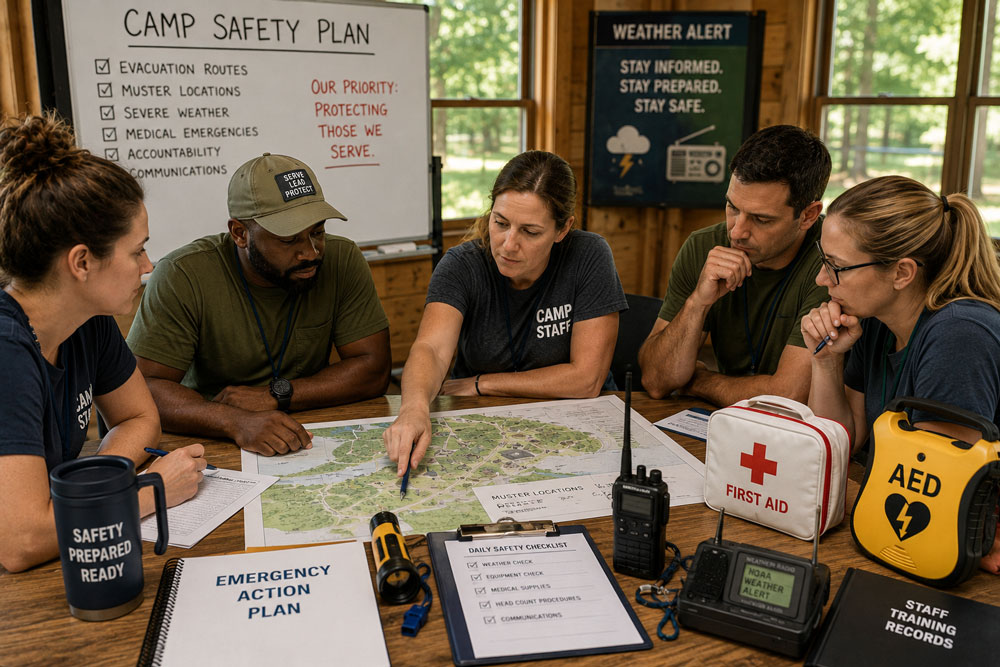
Protecting Those We Serve.
Including Recent Texas Legislative Mandates and National Best Practices
Introduction
Every summer, approximately 26 million children and young people are entrusted to the care of camp operators, church leaders, and program directors at more than 20,000 camps across the United States. These environments, day camps, residential camps, church retreats, Vacation Bible School programs, and faith-based youth gatherings, carry a profound stewardship responsibility: the physical safety and emotional well-being of every participant.
Yet the regulatory framework governing youth camp safety in the United States remains a patchwork of state statutes, local health codes, voluntary accreditation standards, and general workplace safety rules. No comprehensive federal law governs youth camp safety. Congress has introduced camp safety legislation multiple times—including the Children and Youth Camp Safety Act of 1975 and the Youth Camp Safety Act of 1985—but none has been enacted into law. A 1989 Government Accountability Office report found that states met, at best, only 65 percent of minimum CDC health and safety standards for youth camps, with 26 states meeting fewer than half.
The tragic flooding at Camp Mystic in the Texas Hill Country on July 4, 2025, which claimed 27 lives, including those of young campers and counselors, catalyzed the most significant state-level camp safety legislation in recent memory. The resulting laws now serve as a model for organizations nationwide, underscoring that proactive emergency planning is not merely a regulatory obligation but a moral imperative.
This article provides a comprehensive overview of national best practices, emerging regulatory requirements, and actionable guidance for leaders of summer youth camps and faith-based organizations. It gives particular attention to the recently enacted Texas mandates, which represent the new high-water mark for youth camp safety regulation in the United States.
I. The National Regulatory Landscape
Understanding the regulatory environment is the essential first step for any organization operating youth programs. The landscape involves overlapping layers of federal, state, and voluntary standards.
Federal Requirements
Although no comprehensive federal youth camp statute exists, two federal requirements apply broadly. The Occupational Safety and Health Administration (OSHA) requires any employer, including camp operators with employees, whether for-profit or nonprofit, to maintain a written emergency action plan under 29 C.F.R. § 1910.38. This plan must address evacuation procedures, emergency reporting protocols, and designated employee responsibilities. The Centers for Disease Control and Prevention (CDC) has published guidance on health and safety practices for youth and summer camp environments, covering communicable disease prevention, water safety, and environmental health standards.
State-Level Regulation
State regulation is where the primary oversight occurs, and the variation is enormous. An estimated 17 states maintain summer-specific camp regulations, while many others regulate camps under broader childcare licensing frameworks, environmental health codes, or public health statutes. State health departments are the most common oversight agencies, though some jurisdictions assign camp oversight to departments of children and families, labor, or education.
Common state-level requirements, where they exist, typically include criminal background checks (and sex offender registry verification) for all staff and volunteers; minimum staff-to-camper supervision ratios; annual health and safety inspections of camp facilities; written safety and emergency plans, often subject to health department approval; first aid and CPR certification for designated personnel; incident documentation and reporting to state authorities; food service, sanitation, and aquatic safety standards; and, increasingly, provisions for automated external defibrillators (AEDs) and opioid overdose reversal agents.
An important note on organizational structure: the for-profit versus nonprofit distinction generally does not affect safety and health regulatory obligations. Both types of organizations must comply with the same state camp licensing and health code standards applicable in their jurisdiction. The differences between for-profit and nonprofit camps are primarily matters of tax treatment, governance structure, and eligibility for certain grants—not safety regulation exemptions.
II. Industry Best Practices: American Camp Association Accreditation
The American Camp Association (ACA) maintains the most widely recognized voluntary accreditation program for youth camps in the United States. ACA accreditation encompasses more than 200 individual standards, significantly exceeding the approximately 80 criteria found in typical state regulations, and is verified through on-site review by trained professionals at least once every three years.
ACA standards span eight core areas: site and food service; transportation; health care and wellness; operational management (including risk management, safety, security, and insurance); human resources (screening, training, and supervision); program design and activities; specialized activities such as waterfront, equestrian, and challenge courses; and emergency management and crisis communications.
Mandatory ACA standards include staff screening and background verification, fire safety and emergency exits, first aid equipment availability, certified aquatic personnel for waterfront activities, secure storage and use of flammable materials and firearms, emergency transportation capability, and collection and maintenance of participant health information.
For faith-based organizations, ACA accreditation provides a structured, externally validated framework that demonstrates due diligence to families, denominational bodies, insurers, and, where relevant, courts of law. Even organizations that do not pursue formal accreditation should use ACA standards as a baseline for internal safety program development.
III. Safety Planning Essentials for Youth-Serving Environments
Drawing from OSHA requirements, ACA standards, CDC guidance, and the more rigorous state frameworks (including those of New York, New Jersey, Connecticut, and now Texas), the following elements constitute the core of a comprehensive safety and emergency plan for any youth-serving environment.
A. Written Emergency Action Plan
- Evacuation procedures: clearly mapped routes posted in all occupied structures, illuminated for nighttime visibility, with designated muster zones for accountability.
- Shelter-in-place and lockdown protocols: procedures for severe weather, external threats, and active-threat scenarios.
- Scenario-specific response plans: addressing lost or missing participants, severe injuries or medical emergencies, aquatic emergencies, structure fires, unauthorized persons on premises, and natural disasters (floods, tornadoes, hurricanes, and wildfires, as geographically relevant).
- Communication protocols: procedures for notifying local emergency services, internal chain of command, and parents or guardians.
- Designated emergency preparedness coordinator: a named individual responsible for plan maintenance, staff training, and emergency response leadership.
B. Staff Training and Participant Orientation
- Annual training for all staff and volunteers on the organization’s emergency response plan, including hands-on drills and scenario-based exercises.
- Current first aid and CPR certification for designated personnel (note that some states, such as New York, require annual renewal regardless of the certification card’s printed expiration date).
- AED training for at least one staff member on-site at all times, where AEDs are present or required.
- Participant safety orientation within 48 hours of each session’s start, covering facility boundaries, known hazards, behavioral expectations, and age-appropriate emergency procedures.
C. Health Services and Medical Readiness
- A designated health director or medical officer, with a written medical plan that has been reviewed (and, where required, approved) by the appropriate health authority.
- On-site first aid supplies, AED equipment, and, increasingly, opioid overdose reversal agents (naloxone), with trained personnel for each.
- Procedures for medication management, allergy response, and emergency medical transportation.
- Collection of health histories and emergency contact information for every participant prior to arrival.
D. Facility and Environmental Safety
- Regular inspection and maintenance of all structures, activity areas, and equipment.
- Compliance with fire protection codes, including NFPA 1194 for campground-style facilities.
- Aquatic safety protocols, including certified lifeguard staffing for all waterfront activities.
- Weather monitoring systems, including weather alert radios and alert systems that function independently of internet and cellular service.
- Food safety compliance, including a trained food service supervisor where meals are prepared or served.
E. Screening, Accountability, and Reporting
- Criminal background checks and sex offender registry verification for every employee and volunteer prior to their first day of service, repeated annually.
- Incident documentation, with timely reporting to the applicable state licensing authority and to parents or guardians.
- A publicly accessible mechanism (such as a website link to the state licensing agency) for parents, staff, and volunteers to report noncompliance or safety concerns.
IV. Texas Legislative Mandates: A New Standard for Youth Camp Safety
On September 5, 2025, Governor Greg Abbott signed into law two landmark bills passed during the 89th Legislature’s Second Called Session: House Bill 1 (H.B. 1), the Youth Camp Alert, Mitigation, Preparedness, and Emergency Response Act (the “Youth CAMPER Act”), and Senate Bill 1 (S.B. 1), the Heaven’s 27 Camp Safety Act. Together, these laws amend Texas Health and Safety Code Chapter 141 and represent the most comprehensive state-level youth camp safety overhaul in the nation.
The legislation was a direct response to the catastrophic flooding along the Guadalupe River on July 4, 2025, which devastated Camp Mystic in Kerr County and claimed 27 lives. The laws are named in honor of those who perished, and they reflect the urgent demand from families and the public for enforceable safety standards.
A. Emergency Action Plans (H.B. 1, § 141.0091)
Under the Youth CAMPER Act, every licensed youth camp in Texas must develop, annually review, and submit a written, site-specific emergency action plan to the Texas Department of State Health Services (DSHS) for approval. Each plan must address the following:
- Specific muster zones for evacuation and camper assembly.
- Response procedures for lost campers, structure fires, severe injuries, illnesses, fatalities, epidemics, aquatic emergencies (including drownings), and unauthorized persons on the premises.
- Procedures to identify and account for every camper during an emergency event.
- Notification protocols for local emergency services, appropriate camp personnel, and parents or legal guardians of campers.
- Designation of a camper emergency preparedness coordinator.
Deficient plans must be revised and resubmitted within 45 days of notice from DSHS. Approved plans are shared, within 10 business days of approval, with the Texas Division of Emergency Management and stored in a DSHS digital database. Plans submitted to governmental entities are confidential and exempt from public information disclosure requirements.
B. Weather Monitoring and Emergency Warning Systems
The legislation mandates that every youth camp maintain at least two independent methods for receiving severe weather alerts that do not depend solely on internet or cellular service. Specifically:
- An operable weather alert radio capable of receiving real-time National Weather Service alerts must be maintained in each cabin.
- An emergency warning system with public address capability, functional without internet access, must be installed on camp premises.
- Operators must monitor alerts from the National Weather Service, local river authorities, and local emergency notification systems.
- Compliance must be certified annually by the camp operator.
C. Internet Infrastructure and Communications Redundancy
Recognizing that communication failures proved deadly during the Camp Mystic disaster, H.B. 1 requires youth camps to maintain a primary broadband connection using end-to-end fiber optic facilities and a secondary broadband connection from a distinct service provider. This dual-path requirement is intended to ensure that camps retain communication capability even when one service provider’s network fails.
D. Staff Training and Camper Orientation
All staff and volunteers must receive a copy of the camp’s emergency plan annually and must complete mandatory training in its procedures, with training completion documented in written records. Minimum training hours will be established by DSHS rule.
Within 48 hours of the start of each camp session, every camper must receive a mandatory safety orientation that covers the camp’s boundaries, known hazards present on the premises, behavioral expectations during emergencies, and age-appropriate instruction on emergency actions and procedures.
E. Floodplain and Floodway Restrictions (S.B. 1)
The Heaven’s 27 Camp Safety Act imposes the most stringent floodplain restrictions ever applied to youth camps in the United States. DSHS is prohibited from issuing or renewing a license for any youth camp that operates cabins (camper sleeping quarters) within a FEMA-designated 100-year floodplain, with only two narrow exceptions:
- The floodplain area is adjacent to a still body of water (such as a lake or pond) that is not connected to a flowing stream or river.
- The camp is located at least 1,000 feet from a floodway.
For camps with cabins located within 1,000 feet of a floodway, the law requires installation of emergency roof-access ladders on each cabin and development of a flood evacuation plan that activates upon flash flood warnings.
F. Parental Notification and Transparency
The Texas legislation establishes significant new transparency obligations:
- Parents and guardians must receive the camp’s most recent emergency plan before their child’s participation.
- Camps must provide specific written notice if any camp areas are located within a floodplain, and parents must sign a written acknowledgment of receipt.
- Every camp must display a prominent link on its public website to the DSHS Youth Camp Program web page, enabling parents, staff, and volunteers to report noncompliance.
- DSHS must post and maintain an online registry of all youth camps holding active licenses.
G. Camper-to-Counselor Ratios
H.B. 1 directs DSHS to review and establish minimum camper-to-counselor ratios by rule. Published reports indicate a ratio of 1:8 for campers ages 9 through 14.
H. Complaint Investigation and Enforcement
DSHS must investigate every complaint filed regarding youth camp noncompliance, including conducting on-site inspections consistent with existing inspection standards under Section 141.007. DSHS cannot issue or renew a license without full compliance with the emergency plan and infrastructure requirements, and license suspension is mandatory for violations. The law expressly prohibits DSHS from granting waivers from any of the prescribed requirements.
I. Youth Camp Safety Multidisciplinary Team
H.B. 1 creates a Youth Camp Safety Multidisciplinary Team within DSHS, composed of representatives from multiple state agencies, charged with developing proposed minimum standards for youth camps and presenting recommendations to the executive commissioner. The team’s first meeting is required by September 1, 2026.
J. Key Compliance Deadlines
Texas Compliance Timeline
- September 5, 2025:
- H.B. 1 and S.B. 1 signed into law and effective
- January 1, 2026:
- Deadline for DSHS to adopt implementing rules
- March 31, 2026:
- Final submission deadline for camps to secure licensure and demonstrate compliance
- April 1, 2026:
- Deadline for emergency plan submission to DSHS
- September 1, 2026:
- First meeting of the Youth Camp Safety Multidisciplinary Team
V. Practical Recommendations for Leaders, Boards, and Program Directors
Whether your organization operates a week-long day camp, a multi-session residential program, or a weekend faith-based retreat, the following recommendations will strengthen your safety posture and position your organization for compliance with both current and emerging regulatory requirements.
Conduct a Gap Analysis
Begin with an honest assessment of your current safety and emergency plans against the standards described in this article—particularly the Texas mandates, which represent the most detailed state requirements now in force. Identify gaps in documentation, training, infrastructure, and organizational accountability. Even if your state does not currently impose requirements as stringent as those in Texas, aligning with these standards positions your organization to meet the next wave of regulation and—more importantly—to protect the children in your care.
Develop or Update Your Written Emergency Plan
Your plan should be site-specific, reviewed and updated annually, and distributed to all staff, volunteers, and families. It should be scenario-based (covering weather, fire, medical, missing-person, aquatic, and intruder events) rather than generic. Designate an emergency preparedness coordinator by name, and ensure the plan includes muster zones, communication trees, and accountability procedures.
Invest in Staff Training and Drills
Annual training is the minimum standard. Training should include hands-on drills, scenario walkthroughs, and coordination exercises with local emergency services. Document every training session. For faith-based organizations, consider integrating safety training into volunteer onboarding processes and annual ministry leadership retreats.
Upgrade Weather Monitoring and Communication Systems
Even outside Texas, every camp and retreat facility should maintain weather alert radios and emergency communication systems that function without reliance on internet or cellular networks. Evaluate your facility’s broadband redundancy and consider whether a secondary provider is warranted.
Review Your Insurance and Legal Exposure
Ensure that your general liability, directors and officers, and property insurance policies reflect the scope and nature of your youth programs. Discuss the implications of the new Texas legislation with your insurer and your legal counsel, even if you operate outside Texas, as insurers nationwide are increasingly incorporating these standards into their underwriting expectations.
Engage Your Board
Board members of nonprofit camps, churches, and faith-based organizations bear fiduciary and oversight responsibility for safety. Present your safety plan and gap analysis to the governing board at least annually. Document their review and any directives issued.
VI. How Kearnan Consulting Group Can Help
The regulatory requirements and best practices described in this article represent only the starting point for a robust youth safety program. Every organization’s circumstances are unique—shaped by the state and locality in which it operates, the nature and duration of its programs, the characteristics of its facilities, and the populations it serves.
Kearnan Consulting Group provides deeper analysis on any state’s specific licensing and safety requirements, as well as tailored guidance on any component of safety planning—including emergency plan development and review, gap analysis, staff training program design, facility safety assessments, and board governance recommendations. Our team works with summer camps, churches, denominational bodies, retreat centers, and other youth-serving organizations to develop practical, mission-aligned safety programs that meet or exceed applicable standards.
To discuss how we can support your organization, contact us at jeff@kearnanconsulting.com.
Sources and References
The following resources informed this publication:
- American Camp Association, “ACA Facts and Trends,” https://www.acacamps.org/press-room/aca-facts-trends (accessed March 2026). ACA reports more than 20,000 camps serving approximately 26 million campers annually in the United States.
- S.422, 94th Congress (1975–1976), Children and Youth Camp Safety Act; H.R.769, 99th Congress (1985–1986), Youth Camp Safety Act.
- GAO Report HRD-89-140, “Youth Camps: Nationwide and State Data on Safety and Health Lacking” (1989). U.S. Government Accountability Office.
- Office of the Texas Governor, “Governor Abbott Signs Texas Summer Camp Safety Bills Into Law,” September 5, 2025, https://gov.texas.gov/news/post/governor-abbott-signs-texas-summer-camp-safety-bills-into-law.
- 29 C.F.R. § 1910.38, Emergency Action Plans (OSHA).
- CDC, “Considerations for Youth and Summer Camps,” https://stacks.cdc.gov/view/cdc/88187 (accessed March 2026).
- National Child Care Information Center (NCASE), “State Child Care Licensing Regulations for Summer Programs and Camps,” HHS/ACF, https://childcareta.acf.hhs.gov.
- ACA State Laws & Regulations, https://www.acacamps.org/resources/state-laws-regulations (accessed March 2026).
- N.Y. Pub. Health Law § 1394; NYC Health Code Art. 48; NYC DOHMH, “Revised Jan. 2026 Summer Camp Safety Plan,” https://www.nyc.gov/assets/doh/downloads/pdf/camp/camp-safety-plan.pdf.
- American Camp Association, “Standards at a Glance,” https://www.acacamps.org/accreditation/overview/standards-glance (accessed March 2026).
- American Camp Association, “Accreditation Process,” https://www.acacamps.org/accreditation and “Standards at a Glance,” https://www.acacamps.org/accreditation/overview/standards-glance (accessed March 2026).
- S.B. 1, 89th Leg., 2nd Called Sess. (2025), amending Tex. Health & Safety Code ch. 762, requiring campground compliance with NFPA 1194, Standard for Recreational Vehicle Parks and Campgrounds, 2021 Edition.
- Tex. S.B. 1, 89th Leg., 2d Spec. Sess. (2025) (Heaven’s 27 Camp Safety Act).
- Tex. Health & Safety Code ch. 141 (as amended by H.B. 1 and S.B. 1, 89th Leg., 2nd Called Sess. (2025)).
- NewsBreak, “Texas Youth Camps Get Tougher Safety Regulations for 2026,” https://share.newsbreak.com/hvm2dazy (accessed March 2026). See also Perry Weather, “Heaven’s 27 Camp Safety Act: New Texas Law HB1/SB1 Explained,” https://perryweather.com/resources/heavens-27-camp-safety-texas-act/.
- Tex. Health & Safety Code § 141.0091, Youth Camp Emergency Plans (H.B. 1, 89th Leg., 2nd Called Sess. (2025)).
- Texas Senate Bill Analysis, S.B. 1, 89th Leg., 2nd Called Sess. (2025), https://capitol.texas.gov/tlodocs/892/analysis/html/SB00001F.htm.
- S.B. 1, 89th Leg., 2nd Called Sess. (2025), amending Tex. Health & Safety Code ch. 141 (floodplain restrictions and licensing provisions).
- Tex. Health & Safety Code § 141.0092, Internet Infrastructure Requirements (H.B. 1, 89th Leg., 2nd Called Sess. (2025)).
- Tex. Health & Safety Code § 141.0091(f), Camper Safety Orientation Requirements (H.B. 1, 89th Leg., 2nd Called Sess. (2025)).
- Tex. S.B. 1, 89th Leg., 2d Spec. Sess. (2025) (Heaven’s 27 Camp Safety Act).
- S.B. 1, 89th Leg., 2nd Called Sess. (2025), amending Tex. Health & Safety Code ch. 141 (campground and youth camp floodway cabin provisions, roof-access ladders, and evacuation planning requirements).
- Tex. Health & Safety Code §§ 141.0091(d)–(e), 141.009, Parental Notification and Transparency Requirements (H.B. 1 and S.B. 1, 89th Leg., 2nd Called Sess. (2025)).
- Tex. Health & Safety Code § 141.008, Camper-to-Counselor Ratios (H.B. 1, 89th Leg., 2nd Called Sess. (2025)). Reported 1:8 ratio for campers ages 9–14.
- Texas DSHS, Updates on Implementation of New Youth Camp Legislation (Oct. 10, 2025), noting that SB 1 “makes changes to Health and Safety Code Chapter 141” and requires DSHS to implement new rules, inspections, and compliance processes.
- Tex. Health & Safety Code § 141.0081, Youth Camp Safety Multidisciplinary Team (H.B. 1, 89th Leg., 2nd Called Sess. (2025)). First meeting required by September 1, 2026.
- American Camp Association, “Standards at a Glance” and “State Laws & Regulations,” https://www.acacamps.org.
- CDC, “Considerations for Youth and Summer Camps,” https://stacks.cdc.gov/view/cdc/88187.
- GAO Report HRD-89-140, “Youth Camps: Nationwide and State Data on Safety and Health Lacking” (1989).
- H.B. 1 (Youth CAMPER Act) and S.B. 1 (Heaven’s 27 Camp Safety Act), 89th Leg., 2nd Called Sess. (Tex. 2025). Full text available at https://capitol.texas.gov.
- NewsBreak, “Texas Youth Camps Get Tougher Safety Regulations for 2026,” https://share.newsbreak.com/hvm2dazy.
- NYC DOHMH, “Revised Jan. 2026 Summer Camp Safety Plan,” https://www.nyc.gov/assets/doh/downloads/pdf/camp/camp-safety-plan.pdf.
- Office of the Texas Governor, “Governor Abbott Signs Texas Summer Camp Safety Bills Into Law,” September 5, 2025.
- OSHA, 29 C.F.R. § 1910.38, Emergency Action Plans.
- Perry Weather, “Heaven’s 27 Camp Safety Act: New Texas Law HB1/SB1 Explained,” https://perryweather.com/resources/heavens-27-camp-safety-texas-act/.
- Texas DSHS, “Updates on Implementation of New Youth Camp Legislation,” October 10, 2025.
- Texas DSHS, “Youth Camp Guidance, Clarifications, and FAQs,” https://www.dshs.texas.gov/youth-camp-program/youth-camp-guidance-clarifications-faqs.
- Texas Senate, S.B. 1 Bill Analysis, 89th Leg., 2nd Called Sess. (2025), https://capitol.texas.gov/tlodocs/892/analysis/html/SB00001F.htm.
- U.S. Congress, S.422 (94th Congress, 1975–1976) and H.R.769 (99th Congress, 1985–1986).
DISCLAIMER
This article is published by Kearnan Consulting Group for informational and educational purposes only. It does not constitute legal advice, and no attorney-client or professional-services relationship is created by its publication or distribution. The information contained herein is based on publicly available statutes, regulations, and guidance current as of March 2026 and is subject to change. Organizations should consult qualified legal counsel licensed in their jurisdiction for advice regarding state-specific compliance obligations, regulatory interpretation, and risk management. Kearnan Consulting Group expressly disclaims any liability for actions taken or not taken in reliance upon the information contained in this article.