
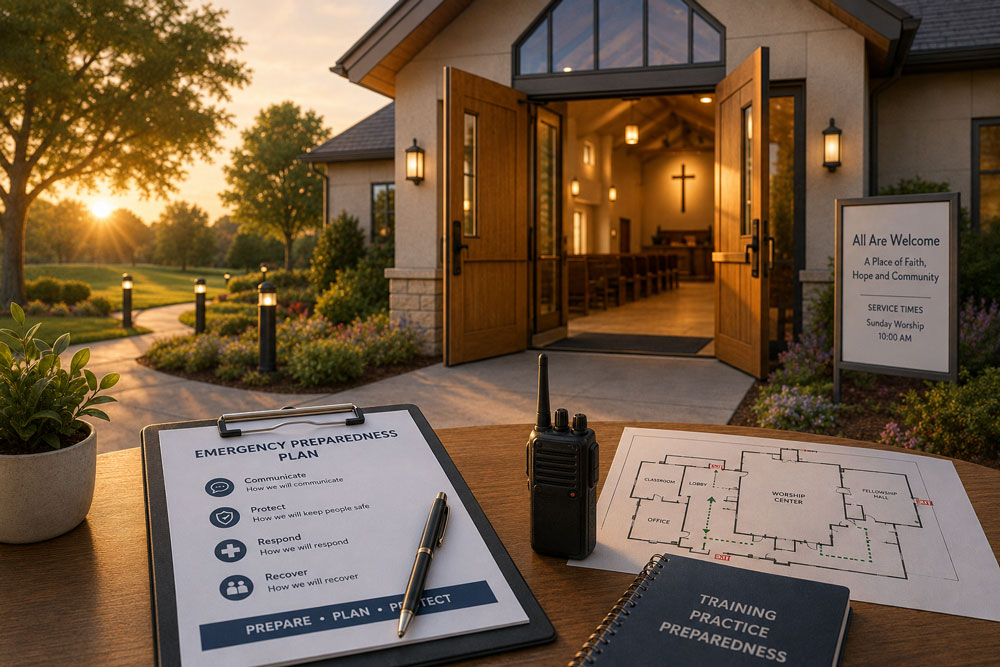
A Word to Our Congregational Partners
Places of worship in the United States remain open doors by design, and that openness is part of what makes them meaningful. It also creates a security challenge that every congregation now shares. This issue of The Sanctuary Watch gives you a clear, sourced picture of the threat facing churches, synagogues, mosques, and other houses of worship, along with the parochial and religious schools attached to many of them. It is followed by a year-by-year snapshot of significant incidents and practical steps your leadership can take. Every figure is drawn from published federal data, established research organizations, or news reporting, with full citations at the end so your team can verify each claim.
| THE TREND IN ONE LINE 1,384 documented acts of hostility against U.S. churches from 2018 through 2024, with the two most recent tracked years, 2023 and 2024, accounting for the large majority of that total. Source: Family Research Council. See citation 1. |
The Multi-Year Trend at a Glance
The Family Research Council, which has tracked hostile acts against U.S. churches since 2018, documented 415 acts of hostility in 2024, affecting 383 congregations across 43 states.1 That total was down from the record 485 incidents in 2023, but it still represents more than eight times the 50 incidents recorded in 2018.1 FRC releases its annual report in the following calendar year, so a full 2025 tally is not yet published; the incident snapshot later in this issue tracks 2025 and 2026 events as they have been reported.
| Year | Documented acts of hostility | Notable shift |
|---|---|---|
| 2018 | 50 | Baseline (first FRC tracking year) |
| 2019 | 83 | Up 66% year over year |
| 2020 | 55 | Dip during pandemic closures |
| 2021 | 98 | Renewed rise |
| 2022 | 198 | Doubled; spike tied to abortion debate |
| 2023 | 485 | Record high to date |
| 2024 | 415 | Second-highest on record |
Source: Family Research Council, Hostility Against Churches in the United States (2025 edition, analyzing 2024 incidents).1
2024 by the Numbers
Vandalism remained the most common form of hostility by a wide margin, but the more violent categories are the ones trending upward. Gun-related incidents at churches more than doubled, rising from 12 in 2023 to 28 in 2024.1 The full 2024 breakdown is shown below.
| Category | 2024 incidents |
|---|---|
| Vandalism | 284 |
| Arson or attempted arson | 55 |
| Gun-related incidents | 28 |
| Bomb threats | 14 |
| Other (assault, disruption, threats) | 47 |
Note: Some incidents fell into more than one category, so figures reflect FRC classifications rather than mutually exclusive counts.1
Geographically, the incidents were widespread. The states reporting the most acts of hostility in 2024 were California (40), Pennsylvania (29), New York and Florida (25 each), and Texas (23).1, 2 Incidents were documented in 43 of the 50 states, underscoring that this is a national concern rather than a regional one.
Rare but Deadly: What the Long-Term Data Shows
Fatal violence at houses of worship is uncommon relative to the number of congregations that gather each week, but when it occurs it is often devastating. Two independent research efforts help put the risk in perspective.
| THE VIOLENCE PREVENTION PROJECT 399 homicide incidents at U.S. houses of worship from 2000 through 2025, claiming 512 lives. In that database, 88% of the facilities were publicly accessible, only 13% had any security system in place, and about 7% of incidents were active-shooter events. The most common motive was a domestic or interpersonal dispute, not ideology. Source: The Violence Prevention Project, House of Worship Homicides database. See citation 5. |
| FAITH BASED SECURITY NETWORK More than 2,700 deadly-force incidents at faith-based organizations have been catalogued since 1999. Firearms were involved about 58% of the time, meaning more than 40% of attacks did not involve an active shooter, and over 77% of incidents began outside, in parking lots or on the grounds rather than inside the sanctuary. Source: Faith Based Security Network, Deadly Force Incident Study. See citation 6. |
The practical lesson from both datasets is the same: security planning cannot focus only on the worst-case mass shooting. Most harm arrives through disputes, domestic situations, and incidents that begin outside the building, which means awareness, access control, and a trained response matter as much as any single measure.
The Federal Hate-Crime Picture
Federal data tells a parallel story for religiously motivated crime more broadly. In its 2024 hate-crime report, released in 2025, the FBI recorded 2,783 religion-based hate crimes, up from 2,699 in 2023 and amounting to roughly one-quarter of all reported hate crimes.3, 4 Anti-Jewish incidents made up close to 70 percent of all religion-based hate crimes, reaching 1,938, the highest figure the FBI has recorded since it began collecting these statistics in 1991.3 Anti-Muslim incidents totaled 228.3 Because these categories include synagogues, mosques, and churches, they are directly relevant to any faith community assessing its own risk.
Significant Incidents Snapshot: Houses of Worship and Parochial Schools, 2024 to 2026
The following is a representative, not exhaustive, list of notable incidents at U.S. houses of worship and the parochial and religious schools tied to them. Entries marked [School] involved a religious school. Casualty figures reflect the most consistent reporting available; totals for the most recent events may be revised as investigations conclude. Figures below count victims and, where noted, exclude attackers.
2024
February 11, Lakewood Church, Houston, TX (Protestant megachurch) A woman entered with a rifle and opened fire before services; two people were wounded, including her seven-year-old son, and off-duty officers stopped the shooter.10
2025
- April 3, Saints Peter and Paul Catholic Church, Seneca, OK (Catholic) The parish priest, Rev. Arul Carasala, was shot and killed.2
- July 13, Richmond Road Baptist Church, Lexington, KY (Baptist) A man who had shot a state trooper opened fire at the church; two people were killed and two wounded before the attacker was stopped.2, 10
- August 27, Annunciation Catholic Church and School, Minneapolis, MN (Catholic parish and K-8 school) [School] During an all-school Mass, a gunman fired dozens of rifle rounds through the stained-glass windows at children in the pews and had barricaded exit doors; two children, ages 8 and 10, were killed and at least 17 others were wounded, most of them children, before the attacker died by suicide.2, 10, 12
- September 28, Latter-day Saints meetinghouse, Grand Blanc Township, MI (Latter-day Saints) An attacker rammed a truck into the building, opened fire, and set it ablaze; four worshippers were killed and eight wounded before police killed the attacker.2, 7, 10
| EMPHASIS: A VIOLENT CLOSE TO 2025 The Minneapolis and Grand Blanc attacks, five weeks apart, were among the deadliest assaults on U.S. houses of worship in years and targeted worshippers gathered for Mass and Sunday services. Both underscore that congregations of every faith tradition, in every region, are potential targets, and that a rehearsed emergency plan can save lives in the first moments of an attack. |
2026 (through mid-July)
- January 7, Latter-day Saints meetinghouse, Salt Lake City, UT (Latter-day Saints) An altercation during a funeral escalated into gunfire; two people were killed and six injured.10
- Early February, Holy Innocents Catholic School, Long Beach, CA (Catholic school) [School] The school was broken into and ransacked, one of a series of vandalism incidents at Catholic institutions that advocacy groups say has forced parishes to divert significant funds to security.13
- March 12, Temple Israel, West Bloomfield Township, MI (Reform Jewish) A man rammed a truck into the synagogue while more than 100 children were inside; the FBI investigated it as a targeted act of violence against the Jewish community, and the attacker was the only person killed.10
- May 18, Islamic Center of San Diego, CA (Sunni Muslim) A gunman opened fire at the mosque; three worshippers were killed, several of them remembered for shielding children during the attack.10
Early 2026 also brought a string of non-fatal but serious incidents, including arson at churches in Oklahoma City and at Beth Israel Congregation in Jackson, Mississippi, and vandalism at congregations in Philadelphia and Denver, showing that property-directed hostility has continued alongside the deadlier attacks.2
A Closer Look at Parochial and Religious Schools
Religious schools sit at the intersection of two vulnerabilities. They carry the open, welcoming posture of a house of worship while gathering large numbers of children in one place each day, and many operate with fewer security resources than public school districts.11 The August 2025 attack on Annunciation Catholic School in Minneapolis, carried out during an all-school Mass, brought national attention to that gap, and it was followed in early 2026 by the ransacking of Holy Innocents Catholic School in Long Beach, California.12, 13
| ANTISEMITISM REACHING THE CLASSROOM 825 antisemitic incidents were recorded at U.S. non-Jewish K-12 schools in 2025, essentially unchanged from 860 in 2024, while incidents at Jewish institutions, a category that includes day schools, totaled 1,129. Overall antisemitic incidents fell 33% from the prior year to 6,274, yet 2025 was the first year since 2019 in which Jewish people were murdered in antisemitic attacks in the United States. Source: Anti-Defamation League, Audit of Antisemitic Incidents 2025. See citation 11. |
Beyond physical attacks, religious schools and their affiliated institutions have faced waves of bomb threats and hoaxes aimed at disrupting operations and instilling fear, a pattern federal authorities have flagged for synagogues, religious schools, and other institutions.11 The practical response mirrors that for houses of worship: a written emergency plan, controlled and monitored entry, drills that involve teachers and staff, and a standing relationship with local law enforcement. Because a school day concentrates risk into predictable hours and locations, even modest measures such as locked and monitored single points of entry during class time can meaningfully reduce exposure.
What the Monthly Picture Looks Like
Averaged across 2024, congregations experienced roughly 35 documented acts of hostility per month.1 That figure counts only incidents that reached public reporting, so the true monthly total is very likely higher. For a local congregation, the practical takeaway is not that an attack is imminent in any given week, but that the baseline level of risk is now high enough to justify a standing, rehearsed security posture rather than an ad-hoc response.
Practical Steps Your Congregation Can Take
Sound security does not require turning a sanctuary into a fortress, and it does not have to conflict with a spirit of welcome. Federal agencies and faith-based security groups consistently point to a layered approach built on planning, people, and partnerships. The measures below draw on guidance from the Cybersecurity and Infrastructure Security Agency (CISA), the Department of Homeland Security, and the findings of the security research cited above.8, 9
- Complete a security self-assessment. CISA offers free tools that walk congregations through identifying vulnerabilities and matching them to practical mitigations.
- Watch the perimeter, not just the doors. Because most incidents begin outside, in parking lots and on the grounds, extend awareness and lighting to the property line rather than focusing only on the sanctuary entrance.
- Build and rehearse an emergency plan. Cover active-shooter, bomb-threat, medical, and vehicle-ramming scenarios, and practice them with staff and volunteers so response is automatic.
- Form a trained safety or usher team. Welcoming greeters serve a dual purpose, hospitality and situational awareness. De-escalation training matters because many incidents grow out of personal or domestic disputes rather than ideology.
- Control and observe entry points. Limit the number of open doors during services, maintain clear sightlines, and consider basic camera coverage and adequate lighting.
- Build a relationship with local law enforcement. Invite officers to walk your facility, share your emergency plan, and establish a direct point of contact before an incident occurs.
- Pursue security grant funding. The FEMA Nonprofit Security Grant Program helps eligible houses of worship pay for target-hardening and preparedness, and is administered through state homeland security offices.
- Join an information-sharing network. The Faith-Based Information Sharing and Analysis Organization and the Faith Based Security Network distribute timely, actionable threat information to member congregations.
In December 2023, DHS also released Physical Security Performance Goals tailored to faith-based communities, a plain-language checklist congregations can use to benchmark and improve their readiness.9 Kearnan Consulting Group is available to help your leadership work through any of these steps and tailor them to your facility and community.
How to Read These Numbers
A note on interpretation, in keeping with our commitment to accuracy. The FRC totals are compiled from open-source and media reports and reflect that organization’s own classifications, so they capture documented incidents rather than every event that occurred.1 FBI hate-crime figures depend on voluntary reporting by thousands of local agencies, and participation varies from year to year.3, 4 Casualty counts for very recent attacks can change as investigations proceed, and the incident list here is representative rather than complete. We present these sources together because, taken as a whole, they give a fuller and more honest picture than any one would alone, and we encourage you to follow the citations to the primary sources.
About Kearnan Consulting Group, LLC
Kearnan Consulting Group, LLC helps houses of worship and other community organizations assess risk, plan for emergencies, and build practical security programs that protect people while preserving the welcoming character of their ministries. This newsletter is provided for general awareness and does not constitute legal, security, or professional advice specific to your organization.
Sources & Citations
1. Family Research Council, Hostility Against Churches in the United States (2025 edition, analyzing 2024 incidents); FRC newsroom announcement. https://downloads.frc.org/EF/EF25H55.pdf
2. The Daily Signal, reporting on 2024 church-attack totals, state-by-state data, and 2025 incidents (Aug. and Sept. 2025). https://www.dailysignal.com/2025/09/29/attacks-churches-9-incidents-shooting-arson-bombings-us-houses-worship/
3. Anti-Defamation League summary of FBI 2024 Hate Crime Statistics (religion-based totals; anti-Jewish and anti-Muslim figures), released August 2025. https://www.adl.org/resources/press-release/anti-jewish-hate-crimes-comprised-nearly-70-all-religion-based-hate-crimes
4. U.S. Department of Justice, Hate Crime Statistics (FBI Uniform Crime Reporting program). https://www.justice.gov/hatecrimes/hate-crime-statistics
5. https://www.theviolenceproject.org/databases/house-of-worship
6. Faith Based Security Network, Deadly Force Incident Study (Carl Chinn).
7. Christian Warrior Training, The 10 Most Violent Church Attacks of 2025. https://www.christianwarriortraining.com/p/the-10-most-violent-church-attacks
8. Cybersecurity and Infrastructure Security Agency (CISA), Protecting Houses of Worship. https://www.cisa.gov/topics/physical-security/protecting-houses-worship
9. U.S. Department of Homeland Security, DHS Releases Physical Security Performance Goals for Faith-Based Communities (Dec. 6, 2023). https://www.dhs.gov/archive/news/2023/12/06/dhs-releases-physical-security-performance-goals-faith-based-communities
10. News reporting and public records on individual 2024 to 2026 incidents (CNN, NBC News, NPR, ABC News) and the Wikipedia compilation, List of attacks against houses of worship in the United States. https://en.wikipedia.org/wiki/List_of_attacks_against_houses_of_worship_in_the_United_States
11. Anti-Defamation League, Audit of Antisemitic Incidents 2025 (incidents at Jewish institutions and K-12 schools). https://www.adl.org/resources/report/audit-antisemitic-incidents-2025
12. International Christian Concern, Fire and Violence: U.S. Christian Institutions Burned and Attacked in 2025; CNN and NPR reporting on the Annunciation Catholic School shooting. https://persecution.org/2025/12/30/fire-and-violence-u-s-christian-institutions-burned-and-attacked-in-2025/
13. The Catholic Association, statement on vandalism at Holy Innocents Catholic School (Long Beach, CA, February 2026). https://thecatholicassociation.org/tca-statement-on-vandalism-at-holy-innocents-catholic-school-and-the-growing-threat-to-houses-of-worship/