
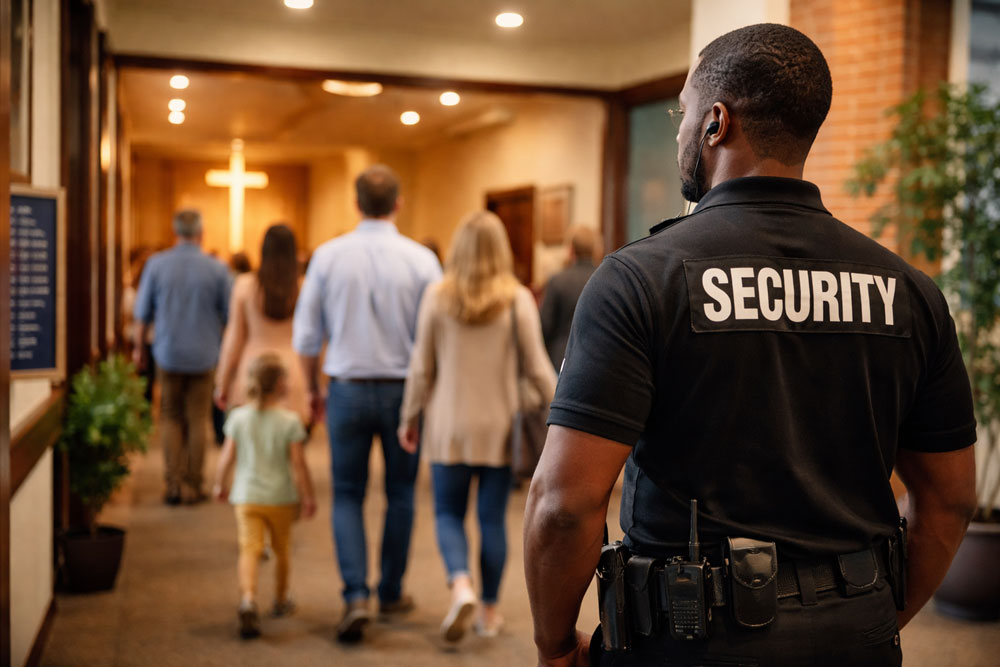
Volunteers in Security Roles, PPO Adoption, and California Statutory Requirements
1. Purpose and Scope
This guideline provides clear, actionable guidance for California houses of worship that wish to use volunteers in security-related roles or functions. It addresses the legal boundaries of volunteer involvement in security, the regulatory framework governing private security in California, and the requirements that must be met if a house of worship considers engaging a Private Patrol Operator (PPO) to manage its security personnel.
This document is intended for church leadership, board members, safety ministry directors, legal counsel advising religious organizations, and private security operators who serve houses of worship.
| IMPORTANT NOTICE This guideline is for informational purposes only and does not constitute legal advice. Houses of worship should consult qualified legal counsel before implementing any security program. Applicable law may change. Always verify current statutes and BSIS guidance. |
2. Key Legal Framework
Two primary sections of the California Business and Professions Code (BPC) govern private security services and establish the employer–employee requirements that affect volunteer use:
2.1 BPC §7574.01 et seq. — Proprietary Private Security
This chapter applies to organizations that employ their own in-house security personnel rather than contracting with an outside security company. Under this chapter:
- An organization performing in-house security functions must register as a Proprietary Private Security Employer (PPSE).
- Security personnel must be hired as employees (Proprietary Private Security Officers, or PPSOs).
- All PPSOs must be registered with BSIS and meet training requirements.
- Volunteers are not recognized as employees under this chapter and therefore cannot serve as PPSOs.
2.2 BPC §7582.27 — Private Patrol Operator Employee Requirement
This section establishes the foundational employer–employee relationship for contract security services. Key provisions:
- Employee requirement. A person performing private security services must be an employee of a licensed Private Patrol Operator (PPO) or a state or local government agency.
- Worker classification. This section is the statutory basis for worker classification, liability, vicarious liability, and wage and hour compliance for security guards.
- BSIS enforcement. BSIS uses this section as a basis for enforcement actions against PPOs that fail to properly employ their guards.
- Scope. If the guard is in-house (not contract security), the employer–employee relationship is governed under BPC §7574.01 et seq., not §7582.27.
3. Core Rule: Volunteers Cannot Perform Regulated Security Functions
| KEY PRINCIPLE California law does not permit volunteer security guards—armed or unarmed—if they are performing actual security functions. If a volunteer performs security functions such as deterrence, patrol, intervention, or threat response, BSIS treats the activity as regulated security work, even if the person is unpaid. |
A volunteer assigned to a church does not automatically fall under either BPC §7574.01 or §7582.27 simply by virtue of being a volunteer. However, the determining factor is the nature of the activity, not the volunteer’s compensation status:
- Unarmed security functions: The church must comply with BPC §7574.01 (PPSE/PPSO), which requires employees—not volunteers.
- Armed security functions: The church must comply with BPC §7582.27 (PPO employee requirement), which also prohibits volunteers.
3.1 What Constitutes Regulated Security Functions
The following activities are considered regulated security work under California law, regardless of whether the person performing them is paid:
| Regulated Security Activity | Why It Triggers Regulation |
| Deterrence (visible security presence) | Acts as a guard function under BPC |
| Patrol of premises | Physical security monitoring of property |
| Intervention in disturbances | Active security response authority |
| Threat assessment and response | Core security guard duty |
| Access control and screening | Restricting entry is a guard function |
| Carrying a firearm in a security role | Requires PPO employment and firearms permit |
3.2 BSIS Clarifications on Prohibited Personnel Categories
BSIS has repeatedly clarified that PPOs cannot use the following categories of unpaid or non-employee personnel in security roles:
- Volunteers
- Interns
- Unpaid workers
- Church-designated “security volunteers”
If the PPO trains, schedules, supervises, or insures the individual, that person is legally an employee regardless of the title used.
4. Using a PPO to “Adopt” Volunteers
Some houses of worship consider engaging a Private Patrol Operator (PPO) to train, license, and insure their volunteers—effectively having the PPO “adopt” the volunteers under its license. This section explains what this arrangement requires under California law and why certain shortcuts are not permissible.
4.1 The Legal Reality of PPO Adoption
| If a PPO adopts volunteers—trains them, licenses them, and insures them—they are no longer volunteers under California law. They become employees of the PPO. |
Once a PPO takes on the management of security personnel, the PPO must fulfill all of the following obligations:
- Pay at least California minimum wage
- Run full payroll (including overtime where applicable)
- Withhold all required federal, state, and local taxes
- Provide workers’ compensation insurance
- Ensure all guards are BSIS-registered and meet training requirements
- Comply with all applicable California labor laws
4.2 Why Volunteers Cannot Perform Commercial Security Work Under a PPO
California only allows volunteer status in non-commercial, charitable, or governmental contexts when the organization itself is the beneficiary. A PPO is a for-profit, licensed business. Security guards working under a PPO are performing commercial security services, even if the end client is a church. Therefore, volunteer status does not apply.
BSIS regulations under BPC §7582.27 require that a PPO must ensure that all guards are employees, all guards are paid, all guards are covered by workers’ compensation, and all guards meet BSIS training and licensing requirements.
4.3 “Stipends” Do Not Solve the Problem
A common misconception is that a PPO can label someone a “volunteer,” not pay them wages, and then charge the church a “stipend” or “administrative fee” for managing them. This arrangement is not lawful under California law.
California law examines the economic reality of a working relationship, not the label attached to it. If the PPO controls the guard’s training, licensing, scheduling, duties, uniform, and reporting, then the guard is an employee and the PPO must pay them. A “stipend” paid to the PPO does not replace wages owed to the guard.
4.4 Churches Cannot Pay the PPO to Avoid Payroll
Even if the church pays the PPO a flat fee for security management, the PPO must still pay the guard, run payroll, provide workers’ compensation, and follow all wage and hour laws. There is no legal mechanism for a PPO to “manage volunteer guards” for a church.
4.5 PPO Involvement: Requirements Summary
| If a PPO Is Involved, It Must… | A PPO May Not… |
| Hire guards as W-2 employees | Use unpaid volunteers for security work |
| Pay at least minimum wage | Call workers “volunteers” to avoid wages |
| Run payroll and withhold taxes | Charge the church a “stipend” in lieu of paying guards |
| Provide workers’ compensation | Classify guards as independent contractors |
| Ensure BSIS registration and training | Skip licensing or training requirements |
| Comply with all CA labor laws | Manage “volunteer guards” for a church |
4.6 When the PPO Is a Nonprofit Organization
Some houses of worship may consider partnering with a nonprofit PPO—or forming one—in the belief that the nonprofit structure changes the volunteer analysis. It does not. The regulatory and employment requirements remain the same regardless of the PPO’s tax-exempt or organizational status.
4.6.1 BSIS Licensing Does Not Distinguish Between For-Profit and Nonprofit PPOs
The Bureau of Security and Investigative Services (BSIS) licenses Private Patrol Operators under BPC §7580 et seq. The licensing requirements—including background checks, insurance, and the employer–employee mandate of §7582.27—apply equally to for-profit corporations, nonprofit corporations, religious organizations, and any other entity operating as a PPO. BSIS does not grant exemptions or modified requirements based on an organization’s tax status or charitable mission.
4.6.2 BPC §7582.27 Applies to All PPOs
The employee requirement under BPC §7582.27 is absolute: all persons performing security services under a PPO license must be employees of the PPO. This obligation is not conditioned on the PPO’s profit motive or corporate form. A nonprofit PPO must hire, pay, and carry workers’ compensation for its security guards in exactly the same manner as a for-profit PPO.
4.6.3 The Volunteer Exception Under Labor Law Is Narrower Than Expected
California labor law does permit volunteer service for nonprofit, religious, and charitable organizations—but only when the volunteer’s work directly benefits the charitable mission of that organization and is not work that would otherwise be performed by a paid employee in a regulated industry. Private security is a regulated industry. Once a nonprofit obtains a PPO license, the security work performed under that license is regulated commercial activity, regardless of whether the organization has a charitable purpose in other areas of its operations.
The California Division of Labor Standards Enforcement (DLSE) and courts apply the economic reality test to determine whether an individual is an employee or a volunteer. The relevant factors include whether the organization controls the individual’s training, schedule, duties, uniform, and reporting—all of which are inherent to PPO-managed security operations. A nonprofit PPO exercising this level of control over its security personnel cannot classify those individuals as volunteers under California law.
4.6.4 A Church Cannot Form a Nonprofit PPO to Use Volunteer Guards
A church that forms its own nonprofit entity and obtains a PPO license does not gain the ability to use unpaid volunteers as security guards. The PPO license itself triggers the full set of regulatory and employment obligations under the BPC and California labor law. The guards must be W-2 employees, must be paid at least minimum wage, must be covered by workers’ compensation, and must meet all BSIS training and registration requirements.
4.6.5 Summary: Nonprofit Status Does Not Change the Analysis
| KEY TAKEAWAY Whether a PPO is organized as a for-profit corporation, a nonprofit corporation, or a religious organization, the legal requirements are identical. BPC §7582.27 requires all security guards to be employees. BSIS does not exempt nonprofit PPOs from any licensing, training, or employment obligation. The economic reality test under California labor law treats individuals performing regulated security work under a PPO’s control as employees, not volunteers, regardless of the PPO’s tax-exempt status. |
| Assumption | Reality Under California Law |
| Nonprofit PPO can use volunteers for security | No — BPC §7582.27 requires employees regardless of PPO’s tax status |
| Charitable mission exempts from BSIS rules | No — BSIS licensing applies equally to all PPO entity types |
| Church-formed nonprofit PPO avoids payroll | No — guards must be W-2 employees with full payroll compliance |
| Nonprofit volunteers are exempt from labor law | No — regulated security work is not eligible for volunteer status |
| Economic reality test is different for nonprofits | No — same factors apply: control of training, schedule, duties, uniform |
5. Compliant Options for Houses of Worship
The following three options represent lawful approaches for California houses of worship seeking to address security needs.
Option 1: Contract with a PPO for Paid Guards (Most Common)
This is the most straightforward and commonly used approach. Under this arrangement:
- The PPO hires, trains, licenses, insures, and pays the security guards.
- The church pays the PPO a contract fee for services rendered.
- The PPO carries all liability, workers’ compensation, and regulatory compliance obligations.
- This model is fully compliant with BPC §7582.27.
| Recommendation: This is the preferred approach for most houses of worship seeking professional security coverage. |
Option 2: Use Volunteers Exclusively for Safety Ministry (Non-Security) Roles
Volunteers may serve in Safety Ministry roles that do not constitute regulated security functions. Permissible volunteer activities include:
- Hospitality and greeting
- Observation and situational awareness (without authority to intervene)
- Reporting concerns to designated security personnel or law enforcement
- Medical response (first aid, AED, CPR)
- Pastoral care and de-escalation through relational ministry
Volunteers in these roles may not perform deterrence, patrol, intervention, threat response, access control, or any armed function.
Option 3: Church Becomes a Proprietary Private Security Employer (Unarmed Only)
A church may register as a PPSE under BPC §7574.01 et seq. to operate its own in-house unarmed security program. Under this option:
- Volunteers still cannot serve as security officers—the church must hire and pay Proprietary Private Security Officers (PPSOs).
- All PPSOs must be BSIS-registered and meet training requirements.
- The church assumes all employer obligations, including payroll, taxes, and workers’ compensation.
- This option is rarely used by houses of worship due to the administrative burden.
6. Quick Decision Guide
Use the following table to determine which regulatory path applies based on the intended role and function:
| Scenario | Volunteer Allowed? | Applicable Law | Required Action |
| Greeting, hospitality, observation only | Yes | None (not regulated) | No security license needed |
| Unarmed patrol, deterrence, access control | No | BPC §7574.01 (PPSE) | Hire paid PPSOs or contract PPO |
| Armed security of any kind | No | BPC §7582.27 (PPO) | Must use PPO with paid, armed guards |
| PPO “adopts” church volunteers | No (they become employees) | BPC §7582.27 | PPO must hire and pay as W-2 employees |
| Church pays PPO a “stipend” for volunteers | No (not lawful) | CA Labor Code + BPC | PPO must pay guards directly |
7. Determining the Applicable Statute
The correct statutory section depends on what the person is doing, not on whether they are called a volunteer. Use the following framework:
If the person performs unarmed in-house security functions:
The house of worship must comply with BPC §7574.01 et seq. The church must register as a PPSE, and the person must be hired as a paid PPSO.
If the person performs armed security functions (or contract security of any kind):
The house of worship must comply with BPC §7582.27. The person must be an employee of a licensed PPO. The PPO must carry all employment obligations.
If the person performs only non-security functions:
Neither statute applies. The person may serve as a volunteer in hospitality, observation, reporting, medical response, or pastoral care roles without a security license.
8. Risks of Non-Compliance
Houses of worship that use volunteers in regulated security roles without proper compliance face significant legal and financial risks:
- BSIS enforcement actions against the church or any PPO involved, including fines, license revocation, and administrative penalties.
- Civil liability exposure if an unlicensed volunteer causes harm while performing security functions.
- Joint employer liability —the church may be considered a joint employer alongside the PPO if it participates in directing, scheduling, or supervising security personnel, significantly expanding the church’s legal exposure.
- Workers’ compensation claims if a volunteer is injured while performing functions that should have been performed by a paid employee.
- Wage and hour violations if BSIS or the California Labor Commissioner determines that volunteers should have been classified as employees.
- Insurance coverage gaps and denial of claims —general liability policies may exclude claims arising from unregulated security activities, and insurance coverage may be denied entirely if the church is using unlicensed or improperly classified personnel.
- BSIS administrative penalties —BSIS may impose fines and administrative penalties on both the PPO and the church for operating outside the scope of California’s private security regulations.
9. Sample Contract Clause for Church–PPO Agreements
The following model contract language may be adapted for use in agreements between a house of worship and a Private Patrol Operator. It is intended to memorialize compliance obligations and prevent prohibited volunteer arrangements. Churches should have legal counsel review and adapt these provisions to their specific circumstances.
| NOTE This sample language is provided for illustrative purposes only and does not constitute legal advice. Consult qualified counsel before incorporating into any agreement. |
Use of Personnel and Prohibition on Volunteers
1. Employee-Only Security Services. The Church acknowledges that under California Business and Professions Code §7582.27 and applicable labor laws, all individuals performing security functions under a Private Patrol Operator (PPO) license must be employees of the PPO. The PPO shall not utilize volunteers, interns, unpaid personnel, or individuals designated by the Church to perform any security-related duties.
2. No Volunteer Substitution or Adoption. The Church and PPO agree that individuals cannot be “adopted,” “sponsored,” or otherwise incorporated into the PPO’s operations as volunteers. Any person trained, scheduled, supervised, uniformed, insured, or directed by the PPO is legally considered an employee, regardless of compensation structure or title.
3. Compensation and Payroll Compliance. The PPO shall comply with all California wage and hour requirements, including but not limited to minimum wage, payroll processing, tax withholding, workers’ compensation coverage, and recordkeeping. The Church shall not provide stipends, honorariums, or administrative fees in lieu of wages owed to PPO employees.
4. Prohibition on Stipend-Based Volunteer Models. The Church acknowledges that California law does not permit a PPO to manage or oversee “volunteer security teams,” nor may the PPO charge the Church a stipend or administrative fee to supervise unpaid personnel performing regulated security functions.
5. Scope of Services. All security services provided under this Agreement shall be performed exclusively by PPO employees who meet BSIS licensing, training, and insurance requirements. Volunteers from the Church may serve only in non-security Safety Ministry roles, which do not include patrol, deterrence, intervention, access control, or any regulated security activity.
10. Recommendations for Church Leadership
- Conduct a role audit. Review every position in your safety ministry and classify each role as either a non-regulated volunteer function or a regulated security function.
- Draw clear boundaries. Ensure that volunteer role descriptions explicitly exclude regulated security functions such as deterrence, patrol, intervention, and threat response.
- Engage a licensed PPO for security needs. If your house of worship requires deterrence, patrol, armed response, or any other regulated security function, contract with a licensed PPO that hires, trains, and pays its guards.
- Avoid PPO “volunteer adoption” arrangements. Do not enter into arrangements where a PPO claims to manage, license, or insure your volunteers without employing and paying them. This is not lawful under California law.
- Consult legal counsel. Before implementing or modifying any security program, consult with an attorney experienced in California private security regulation and employment law.
- Document everything. Maintain written role descriptions, training records, and contracts with any PPO. This documentation provides critical protection in the event of a BSIS inquiry or legal dispute.
11. Statutory Reference Summary
| Statute | Governs | Key Requirement |
| BPC §7574.01 et seq. | In-house (proprietary) unarmed security | Must register as PPSE; hire paid PPSOs |
| BPC §7582.27 | Contract security and armed security | Guards must be W-2 employees of a licensed PPO |
| California Labor Code | Employment classification | Economic reality test; volunteers cannot perform commercial security work |
12. Executive Summary for Boards and Leadership
| EXECUTIVE SUMMARY California law does not permit volunteer security guards under a PPO. Any person trained, supervised, or insured by a PPO is legally an employee and must be paid. A PPO cannot use volunteers, interns, unpaid workers, or church-designated “security volunteers” in any capacity. Churches cannot pay a PPO a “stipend” in lieu of wages, and any such arrangement exposes both the PPO and the church to BSIS enforcement actions, joint employer liability, potential insurance claim denials, and wage and hour violations. Church volunteers may serve only in non-security Safety Ministry roles such as hospitality, observation, reporting, medical response, and pastoral care. For all regulated security functions, the church should contract with a licensed PPO that hires, trains, and pays its own employees. |
13. Endnotes and Statutory References
The following endnotes provide the statutory and regulatory citations supporting the guidance contained in this document. All references are to California law as of the date of publication.
1. California Business and Professions Code §7574.01 et seq.. Establishes the Proprietary Private Security Employer (PPSE) regulatory framework. Requires organizations that employ their own in-house security personnel to register with BSIS and to hire security officers as employees (PPSOs). Volunteers are not recognized as employees under this chapter.
2. California Business and Professions Code §7582.27. Requires that all persons performing private security services must be employees of a licensed Private Patrol Operator (PPO) or a state or local government agency. This is the statutory foundation for the employer–employee requirement in contract security and armed security contexts.
3. California Business and Professions Code §7580 et seq.. Governs the licensing and regulation of Private Patrol Operators. Licensing requirements—including background checks, insurance, and the employer–employee mandate—apply equally to for-profit and nonprofit entities.
4. California Business and Professions Code §7582.1 et seq.. Defines regulated security guard functions, including deterrence, patrol, intervention, access control, and threat response. These functions trigger BSIS licensing requirements regardless of compensation.
5. California Labor Code §1720.4. Addresses volunteer status in the context of public works. California courts and the DLSE apply analogous principles to determine volunteer eligibility in the private sector, requiring that the work be non-commercial and directly benefit a charitable organization.
6. California Labor Code §§200–244. Establishes wage and hour requirements, including minimum wage, overtime, and timely payment of wages. These requirements apply to all employees, including security guards employed by a PPO.
7. DLSE Economic Reality Test. The California Division of Labor Standards Enforcement applies the economic reality test to determine whether an individual is an employee or volunteer. Factors include control over training, scheduling, duties, uniform, and reporting—all inherent to PPO-managed security operations. See Borello & Sons, Inc. v. Dept. of Industrial Relations (1989) 48 Cal.3d 341.
8. S.G. Borello & Sons, Inc. v. Dept. of Industrial Relations (1989) 48 Cal.3d 341. The California Supreme Court established the multi-factor economic reality test for determining employment status. This test examines the totality of the working relationship, not the label assigned by the parties.
9. Dynamex Operations West, Inc. v. Superior Court (2018) 4 Cal.5th 903. Adopted the ABC test for determining worker classification under California wage orders. Under this test, a worker is presumed to be an employee unless the hiring entity can establish all three prongs: (A) the worker is free from control, (B) the work is outside the usual course of business, and (C) the worker is customarily engaged in an independently established trade. Security guards working under a PPO typically fail all three prongs.
10. California Labor Code §3700 et seq.. Requires employers to provide workers’ compensation insurance for all employees. A PPO must carry workers’ compensation for its security guards. Failure to do so exposes both the PPO and client organizations to significant liability.
11. California Business and Professions Code §7583.2. Establishes training requirements for security guards, including the Powers to Arrest training and annual continuing education. All guards must complete required training regardless of the PPO’s organizational structure.
12. Joint Employer Doctrine — Martinez v. Combs (2010) 49 Cal.4th 35. The California Supreme Court held that an entity may be a joint employer if it exercises control over wages, hours, or working conditions, or suffers or permits work to be done, or engages the worker. A church that directs, schedules, or supervises PPO-managed security personnel may be deemed a joint employer.
13. California Insurance Code §11580 et seq.. Governs workers’ compensation insurance requirements. General liability policies may exclude coverage for claims arising from unregulated or unlicensed security activities, creating significant exposure for churches using improperly classified volunteers.
14. BSIS Administrative Citations and Penalties. BSIS has enforcement authority under BPC §7587.7 to issue citations, impose fines, and revoke or suspend PPO licenses for violations of the Private Security Services Act, including the use of unlicensed or improperly classified personnel.
| DISCLAIMER This guideline is provided for informational and educational purposes only. It does not constitute legal advice, and no attorney–client relationship is formed by its use. California statutes, regulations, and BSIS interpretations are subject to change. Houses of worship should consult with qualified legal counsel before making decisions regarding security personnel, volunteer roles, or PPO engagement. |